Whenever the government announces a new social benefit, whether it’s higher minimum wages or bigger discounts for seniors and PWDs—it’s naturally met with public celebration and positive headlines.
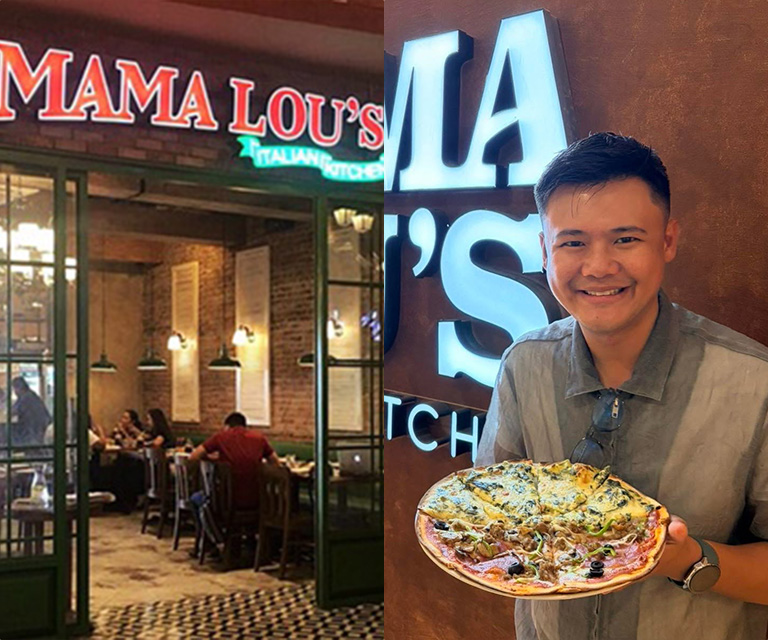
However, as Mama Lou’s CEO David Sison recently pointed out in the local dining community, there’s a heavy catch to these popular policies.
The government isn’t actually funding them.
Instead, the financial burden falls squarely on locally owned private businesses, leaving everyday entrepreneurs to foot the bill for the country’s social safety nets.
Furthermore, this ongoing debate highlights a growing friction between government policy and business sustainability. Of course, everyone agrees that senior citizens, PWDs, and hardworking employees deserve social perks, meaningful support, and fair wages. Yet, the current regulatory framework forces private companies.
Particularly those in the food and beverage industry—to shoulder the vast majority of these costs out of their own revenue.
Small Businesses Bearing The Bigger Weight
To put this structural issue in perspective, back in 1992 under Republic Act No. 7432, establishments could claim a full 100% tax credit for mandated senior citizen discounts. This meant businesses were directly reimbursed by the state for granting benefits on its behalf.
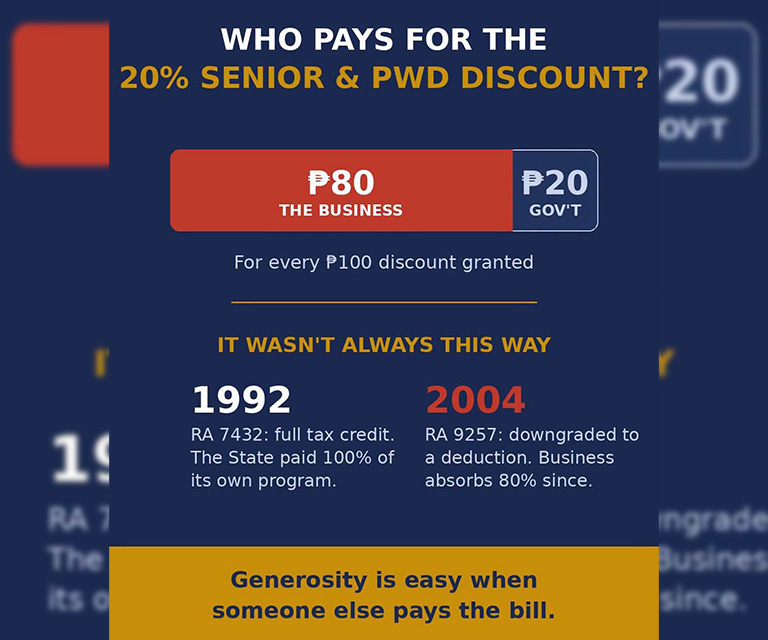
However, due to a legislative shift in 2004 under Republic Act No. 9257 (and retained in subsequent laws like RA 9994 and RA 10754), that tax credit was replaced with a mere tax deduction.
As Sison pointed out:
Today, for every 100 pesos of discount we grant, we recover only 20. The other 80 comes from the business,”
Because of this mechanism, establishments must absorb 80% of the discount directly from their gross margins, all while facing intense customer pushback and public backlash whenever menu prices inevitably rise to cover operational losses.
Importantly, this financial pressure extends far beyond major dining chains with deep pockets.
It severely impacts smaller, independent enterprises—like local carinderias, neighborhood pharmacies, sari-sari stores, and small family bistros—that operate on razor-thin profit margins.
In addition to absorbing mandatory discounts and VAT exemptions, business owners must repeatedly absorb mandated regional wage hikes without receiving any matching tax breaks or structural support from the government. Combined with recurring compliance fees, local permits, health inspections, and administrative reporting requirements, entrepreneurs are trapped in a tight spot.
While politicians take full public credit for expanding social welfare programs, private employers are left paying the actual price.
As Sison bluntly framed the issue:
Generosity is easy when someone else pays the bill.”
Survival Is An Achievement, Not A Failure
Echoing these concerns, Tatung’s Restaurant owner Chef Tatung emphasized that speaking out about rising costs, shrinking margins, and mounting operational demands isn’t about making excuses or complaining.

Rather, it is simply acknowledging a harsh business reality that many owners suffer through in silence. He stated:
Survival is not failure. Sometimes, survival is the achievement.
If thousands of entrepreneurs are carrying the same burden, perhaps it’s time we stop carrying it separately. Sana magkaisa tayo.”
Indeed, with soaring electricity rates, fuel price volatility, commercial rent hikes, and mandatory benefits mounting all at once, running a food service establishment today has become vastly harder than it was a decade ago.
Thus, Chef Tatung reminded fellow entrepreneurs that struggling in this environment does not mean a business is poorly managed or that an owner is weak. Simply opening your doors each morning, paying suppliers on time, keeping staff employed, and meeting payroll before taking care of yourself is a major achievement in its own right.
Therefore, business owners must stand together instead of carrying this heavy load alone.
Moving Toward Shared Responsibility
Ultimately, the goal of local entrepreneurs is not to strip away essential benefits from senior citizens, PWDs, or workers.
Everyone recognizes the immense value these groups bring to our communities. Instead, business owners are calling for a far more equitable funding model where the government truly shares the financial responsibility of its own mandates.
As local dining chains and small businesses navigate rising operational overhead, fixing broken cost structures becomes vital for long-term economic stability.
By revisiting how government promises are financed, the nation can continue to support its most vulnerable communities without crushing the very businesses that keep the economy alive and thriving.
Read more Stories on Simpol.ph
Body Is The Archive: Pamela Maceda On The Naked Act Of Reclaiming
Regional Is National: Aubrey Savet Earns Spot and Complete FDCP’s Master Series In Acting