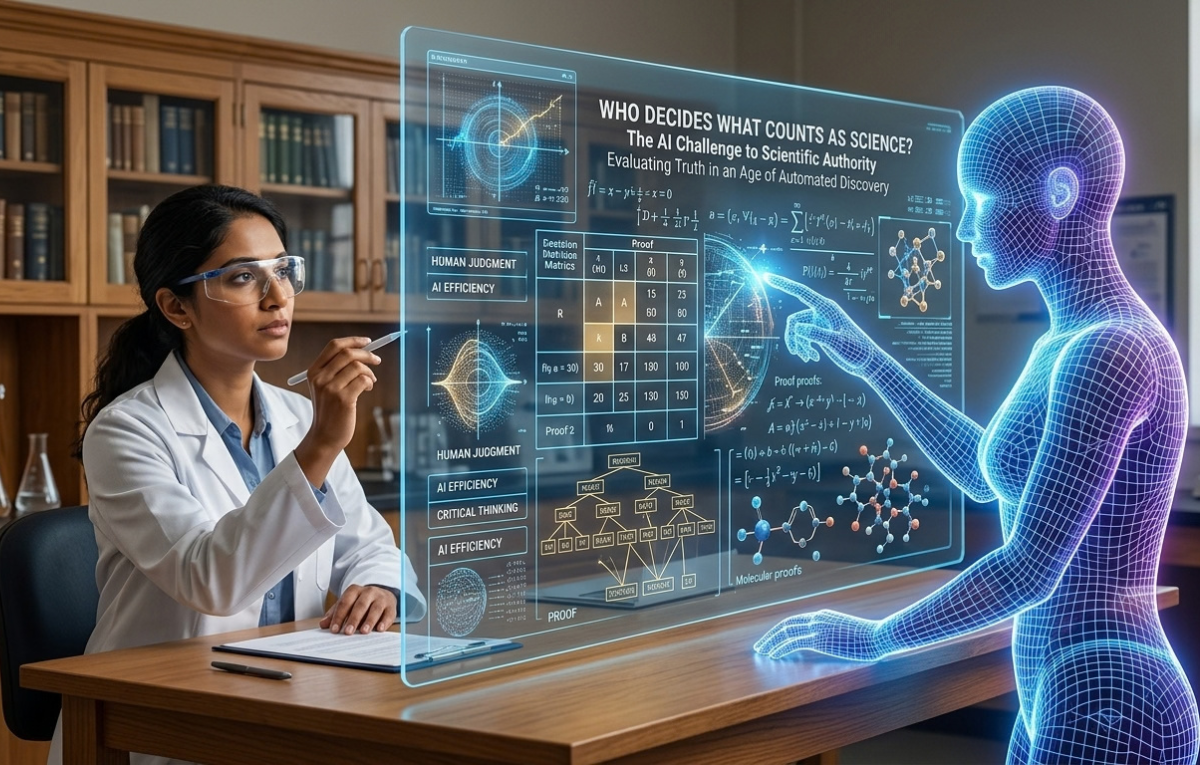
Artificial intelligence is beginning to appear in stories once reserved for scientists themselves. Google DeepMind’s AlphaTensor and AlphaEvolve systems have generated improved solutions to fundamental mathematical problems, discovering faster matrix multiplication algorithms than previously known. In September 2026, Nature reported that an AI system had converted one of mathematics’ most famous proofs, Fermat’s Last Theorem, into a 13-million-line, computer-verified version in just eleven days. The AI did not discover the proof; it translated an existing human argument into a form that a computer could check step by step—a task expected to take years.
That is one track. Another runs alongside it. Preprint repositories such as arXiv are filling with unreviewed papers asking whether artificial intelligence might display consciousness, identity, or deception. Some make provocative claims about “functional consciousness” in large language models; others argue existing theories cannot evaluate future systems. Yet once picked up by social media and news outlets, a preprint can rapidly become “science” in the public imagination.
One track puts machines inside the machinery of proof. The other turns machines into subjects of claims that circulate faster than they can be judged. Both raise the same question: When, exactly, does a claim become scientific knowledge?
How Science Builds Reality
Most of us encounter science as a collection of finished facts: the Earth revolves around the Sun; microorganisms cause disease; DNA carries genetic code. Textbooks present these facts so cleanly that scientific knowledge can appear to be something simply picked up in nature and written down.
Science does not work that way. Before an observation becomes accepted knowledge, scientists must agree on an extraordinary range of things: what counts as evidence, which instruments to trust, how measurements should be taken, what terminology means, and whether a finding survives criticism. Science is more than a methodology—it is a human community organizing reality.
A researcher cannot simply announce a discovery and claim it as part of science. Others must examine the evidence, criticize the method, reproduce the result, and connect it to existing knowledge. Science therefore built an elaborate social infrastructure: universities, laboratories, journals, conferences, and peer review. These institutions established standards and trained specialists, but they also controlled entry. For centuries, participating seriously in science required access to elite networks and expensive facilities. Science became trustworthy partly because not everyone could easily do it.
The Infrastructure of Trust
Artificial intelligence disrupts every part of that arrangement. Preprints had already weakened journals’ control over the circulation of scientific knowledge. AI pushes that shift even further, allowing researchers to search, summarize, and synthesize vast literatures at a speed no individual could match. AI is separating the functions once bundled by universities, offering researchers anywhere an assistant that searches literature, translates, analyzes data, writes code, and helps draft scientific text.
Crucially, AI is entering the machinery of discovery itself. AI systems can now help scientists design experiments, test large numbers of possible solutions, and suggest new hypotheses. Some can even generate possible answers, test them automatically, and improve them repeatedly. AI does not merely help scientists communicate—it directly participates in producing methods, solutions, and checked arguments.
Then there is evaluation. Peer review developed in a world of human scarcity: limited researchers, manuscripts, and time. AI scales production without expanding the human day. If research expands faster than communities can evaluate it, the bottleneck shifts from producing claims to judging them.
Delegating that judgment to machines creates new risks. A computer can check whether a mathematical proof follows the rules it has been given; it cannot decide whether the question matters, whether the assumptions make sense, or whether scientists should trust the result.
This forces a reconsideration of expertise. Traditional scientific work—knowing literature, running calculations, analyzing data, and writing scientific prose—can now be AI-assisted. What becomes far more valuable are qualities harder to automate: judgment, skepticism, methodological intuition, and asking worthwhile questions. Lowering the cost of entry allows almost anyone to generate something that looks like a scientific claim, but weakening institutional gates also risks eroding the mechanisms through which science learned to trust itself.
The Burden of Judgment
Society shapes science, and science shapes society. Human communities decide which questions deserve attention and which methods are legitimate, returning that knowledge to the public through medicine, technology, policy, and law.
AI enters directly into this cycle, bypassing old channels, crossing disciplines, and accelerating output. Removing gatekeepers does not remove the need for truth-building, nor does it leave decisions to no one. Traditional institutions are already being joined by AI systems that summarize research, check mathematical arguments, evaluate results, and help decide which claims deserve attention.
Observation, testing, replication, and empirical evidence do not become obsolete when machines generate hypotheses faster; they become essential. What AI destabilizes is not scientific rigor itself, but the human institutional network that historically enforced it.
A computer-checked proof is not yet a community’s knowledge. In July 2026, an AI-assisted mathematical proof appeared to overturn a famous unsolved problem. The software checked the proof and declared it valid, and another automated checker agreed. But researchers later found that the argument had exploited a flaw in the checking software itself. The claim was false, but the machines had accepted it. Human scrutiny was still necessary.
For centuries, science struggled with who was allowed to produce knowledge. AI shatters much of that gatekeeping. But in doing so, it leaves a harder question standing: software can check the syntax of our proofs, but who decides what is true?
Read more stories on Simpol.ph
No Safety Net: Chef Danilo Puga Teaches the Next Generation to Fear Less
Burrow Cafe: A Cozy Hideaway Built on Family, Food, and Craft