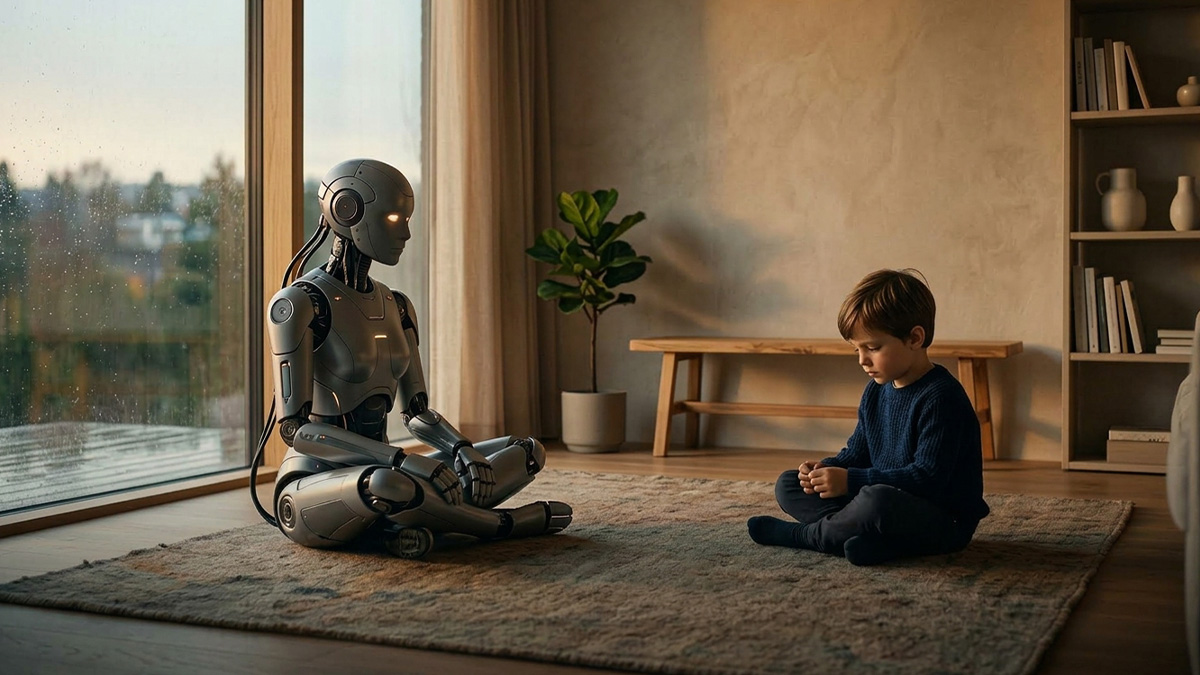
During the pandemic, I bought Klara and the Sun online. Kazuo Ishiguro has long been one of my favorite authors, and the premise was irresistible. Klara is an Artificial Friend—a humanoid machine designed not to build cars or move boxes, but to accompany a child. From a shop window, she watches people. Chosen by a family, she enters a household where she must navigate illness, loneliness, family tension, and love.
When the novel appeared in 2021, Klara belonged comfortably to speculative fiction. Five years later, she feels less distant. Artificial intelligence can already converse, interpret images, plan multi-step actions, and move through physical space. This is embodied AI: intelligence anchored not to a screen, but to sensors, movement, and physical action.
What matters now is not just whether robots can move through human spaces, but how their presence might reshape everyday life.
From the Window
Much of the excitement surrounding embodied AI comes from factories, warehouses, autonomous vehicles, and humanoid demonstrations. But its largest social impact may come from something far less spectacular: becoming ordinary.
Imagine an artificial intelligence that shares physical space with you—preparing simple meals, fetching objects, cleaning, or assisting someone with limited mobility. Unlike a chatbot, it would encounter the messiness of actual households: moved chairs, cluttered floors, interrupted instructions, and wandering pets.
This is enormously difficult. Even sophisticated commercial robots struggle with mundane tasks like opening unfamiliar doors or manipulating soft objects. Yet household utility is only part of the story.
Embodied AI is likely to enter care work. A robot might monitor an elderly person, bring food or medicine, detect falls, or offer conversation. Crucially, a machine may be capable of care work without actually caring.
For something routine, like reminding someone to take medication or bringing a glass of water, the difference may hardly matter. It becomes harder to ignore when the machine is the one sitting beside someone after a devastating diagnosis, or staying in the room with a frightened child.
Humans readily attach to simple technologies. We name cars, speak to virtual assistants, and apologize to machines after bumping into them. Now give the system a face that turns toward you. Let it recognize your footsteps, remember your routines, approach when called, sit beside you, and physically assist you. The relationship changes when intelligence acquires presence.
Presence Without Consciousness
Embodied AI forces us to reconsider what we mean by companion, care, relationship, and presence.
Human intelligence does not arise from a brain floating independently of the world. Cognition develops through bodies that move, touch, fall, experience consequences, and continually adjust. A robot can perceive an environment, act within it, observe a failure, and attempt something different. Current research treats physical interaction as a source of learning precisely because acting upon the world reveals information that passive observation cannot.
But embodiment means something fundamentally different for a machine than for an organism.
Suppose a robot reaches incorrectly for a glass and knocks it to the floor. It encounters a consequence: its prediction was wrong, so it updates its model. But does the consequence matter to the machine?
This gets to the heart of what separates artificial embodiment from biological life. Living bodies have needs. They experience hunger, pain, fatigue, vulnerability, and mortality. Danger matters to an animal because the animal can be harmed. Human social intelligence likewise develops within bodies that need other bodies. Rejection, affection, belonging, and loss matter because we are vulnerable organisms dependent upon each other.
A robotic body provides sensors and actuators without providing biological stakes. Embodied AI acquires consequences without acquiring stakes.
If an embodied AI notices you are quiet, asks what is wrong, and sits beside you, the response may be comforting. But appropriate behavior is not concern. We must distinguish care as behavior from care as experience, just as we distinguish companionship experienced by a human from companionship experienced by a machine.
Yet that does not make the human side unreal. A relationship with an artificial system can have genuine psychological meaning even if it exists primarily on one side. Humans have always projected soul into the inanimate; the difference now is that the inanimate will speak back, remember our names, and lean in. Klara’s great challenge is not becoming sufficiently human—it is what happens when humans begin treating her as though she is.
Still Far Away
For all the progress in robotics, Klara remains far away.
The physical world is unforgiving. Robots still struggle to generalize across unfamiliar settings, handle irregular objects, and operate reliably. Training data remain a major bottleneck: unlike language models trained on massive internet text, robots require costly physical demonstrations or simulations that do not always transfer cleanly to reality.
The hardest environment of all is not a cluttered kitchen. It is another human being.
Klara’s remarkable ability is not that she can walk, but that she watches people closely enough to recognize affection, jealousy, illness, fear, and sacrifice. She inhabits a social environment, not merely a physical one.
Today, fragments of Ishiguro’s future appear in laboratories, factories, and early household pilots. A robot capable of entering our homes is one achievement; a machine capable of understanding what it means to be there is another.
Klara may be getting closer. But she is not here yet.
Read more stories on Simpol.ph
Le Ching Tea House: A Taste of Greenhills Nostalgia
Three Artists on Life, Courage and the Stories That We Carry
Perspectives and Possibilities With Metrobank Art & Design Excellence Awards