There was a time when turning 25 or 30 meant upgrading to “mature” hobbies. Buying a complex espresso machine, learning the tax code, or pretending to understand golf.
But look around today, and you’ll find a 28-year-old corporate analyst spending their Saturday night hunching over a 1,000-piece LEGO set. Step into a local café, and you might see a 25-year-old remote worker relaxingly coloring a 100-page mandala design book.

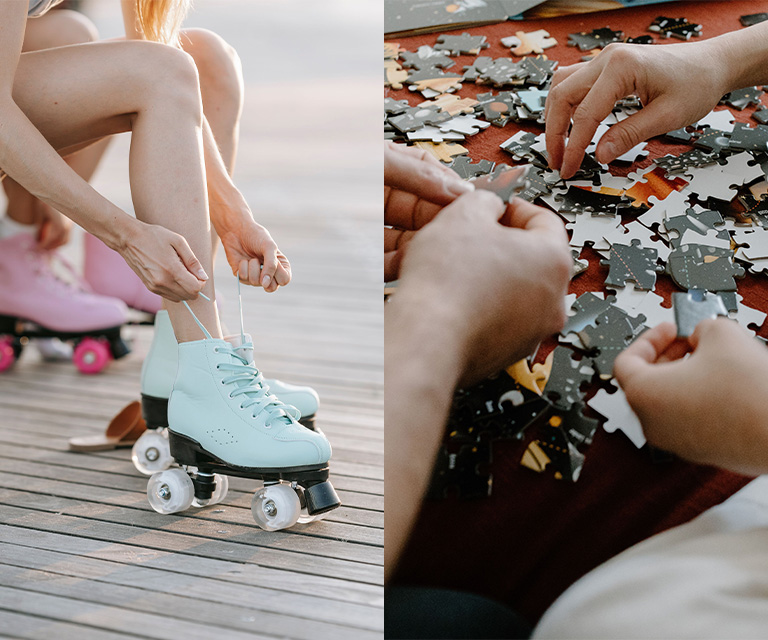
On social media, millions of young adults are unboxing Pokémon cards, buying roller skates, and filling coloring books with meticulous pastel gradients.
Adults aren’t just outgrowing their youth anymore—they are actively running back to it. Gen Z and Millennials are leading a massive cultural pivot back to childhood hobbies. It’s not just a passing trend.
It’s a collective, therapeutic lifestyle movement.
The Ultimate Digital Detox, Bonus: with Tangible Results
We live in an era of “infinite scroll.” For Gen Z, the digital natives, and Millennials, the digital pioneers, life is mediated by screens, notifications, and algorithms. Work happens on a screen; relaxation happens on a slightly smaller screen.
Childhood hobbies offer a glorious escape hatch from the digital matrix. You cannot easily text your boss while your hands are covered in pottery clay. Nor can you scroll TikTok while navigating a pair of quad roller skates.
These activities require tactile engagement. Building blocks, knitting needles, and watercolor brushes provide a sensory, physical reality that a glowing screen simply cannot replicate. At the end of the hour, instead of a spike in screen time, you have something real to show for it. A plastic castle, a lumpy scarf, or a fully painted miniature figurine.

Radical Comfort Food for the Soul
Let’s face it, the last few years have felt like a chaotic simulation. Between economic uncertainty, global health crises, and the general pressure of modern adulthood, young people are exhausted.
Psychologists refer to this nostalgia-driven return as a comfort response. When the present feels unpredictable and the future feels daunting, the past represents safety. Returning to a hobby you loved at age ten triggers a sense of psychological security.
Engaging in a childhood pastime taps into an established mental pathway. Your brain remembers the unburdened joy of that activity from decades ago, instantly lowering your cortisol levels.
It’s the psychological equivalent of a bedtime warm milk.
Rewriting the Rules of Productivity
We live in a hyper-optimized “hustle culture.” For years, young adults were told that every hobby needed a monetization strategy. If you bake, you should start a bakery. If you write, you should launch a paid newsletter.
Reclaiming childhood hobbies is an act of quiet rebellion against this pressure. No one is buying a Tamagotchi or collecting Sonny Angels to build a corporate empire. They are doing it purely because it is fun.
I spent years trying to build and add to my side hustles,” says JJ, a 32-year-old corporate worker. “When I picked up a deck of limited edition fresh Pokemon cards, I realized how much I missed doing something just because it felt good. There’s no KPI for unboxing a deck of Pokemon cards.” he added.
It allows adults to embrace the joy of being wonderfully mediocre at something. All free from the weight of judgment or a performance review.
The Search for “The Third Place”
Historically, human beings had three core spaces: home, work, and community spaces. In the modern, post-remote-work world, the boundaries between home and work have blurred, and traditional community spaces have dwindled.
Childhood hobbies have become a passport to new, vibrant communities. Board game cafes are packed with young adults rolling dice on a Tuesday night. Local yarn shops are filled with Gen Z knitters sharing patterns. These hobbies create safe, low-stakes environments to meet people and build authentic, real-world connections over a shared, joyful interest.
Staying Young to Stay Sane
Returning to childhood hobbies isn’t about refusing to grow up. It’s about figuring out how to survive the process. It’s a brilliant, intuitive self-care strategy that allows the modern workforce to unplug their minds, recharge their spirits, and remember who they were before the world told them who they had to be.
So, if you’ve been secretly wanting to buy that box of 64 Crayola crayons with the sharpener on the back—this is your sign. Go play. Your inner child is waiting.
What childhood hobby or past-time activity have you found yourself drawn back to recently?
Read more Stories on Simpol.ph
The New and Improved Happy Hour
The Doomscroll Apocalypse: Linda Walker and The Digital Reality in portrait mode