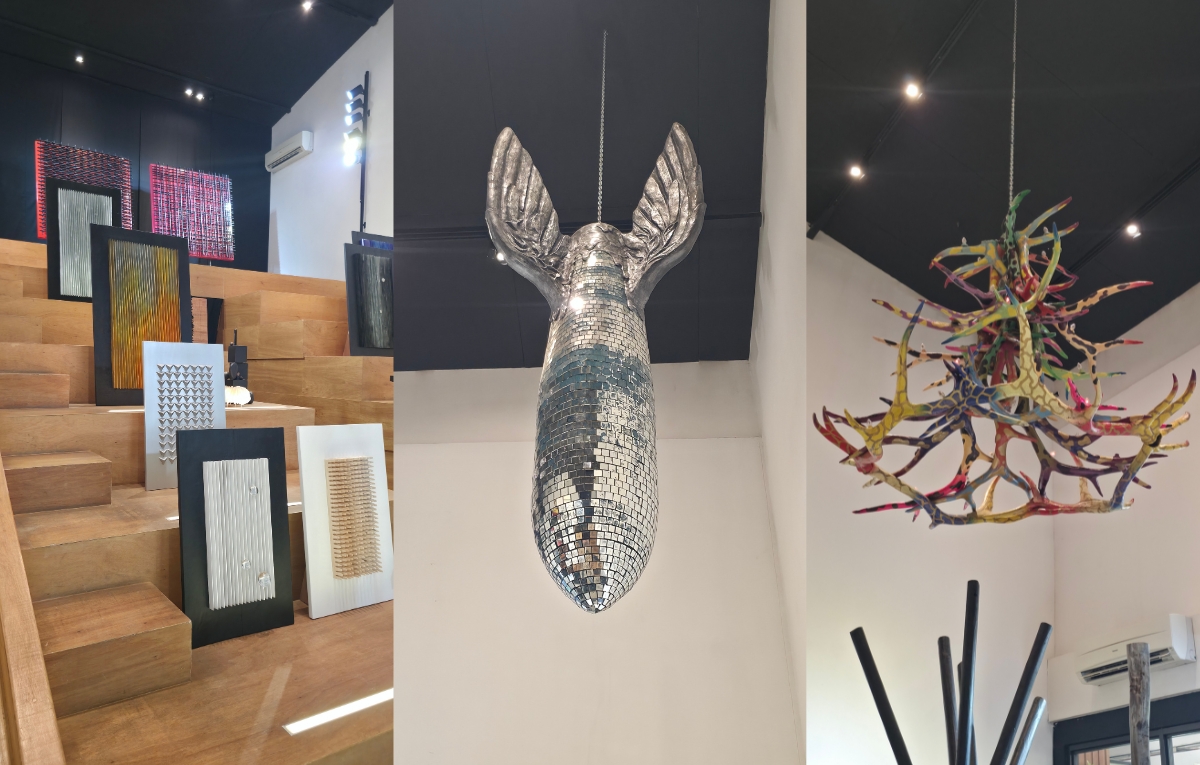
Stepping into Aphro Living Art/Design in Makati feels less like entering a white cube and more like crossing into a quiet sanctuary shaped by the elements. Here, celebrated designer Milo Naval unveils Yakisugi, his first solo fine art show—a milestone that expands his creative practice beyond furniture and interiors while remaining deeply rooted in craftsmanship.
Forged through fire, balanced by water, and grounded by earth, Yakisugi transforms familiar materials into sculptural works that invite viewers to slow down, look closer, and reconsider the beauty found in nature’s everyday rhythms.
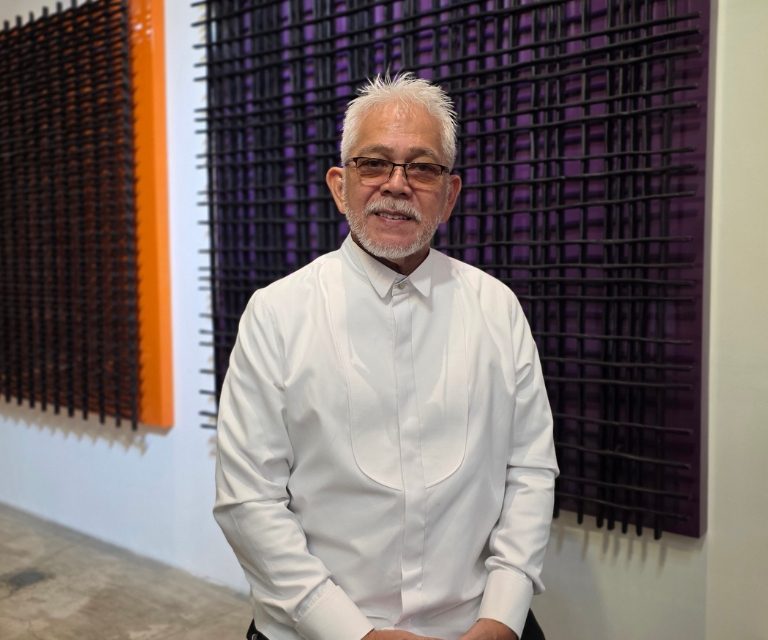
The Art of Preservation Through Fire
For Naval, the exhibition begins with a centuries-old Japanese technique that has fascinated him for years. Yakisugi, the traditional practice of preserving wood by charring its surface, became both his title and his creative framework.
One of the reasons why I chose yakisugi is because of the method,” Naval says.
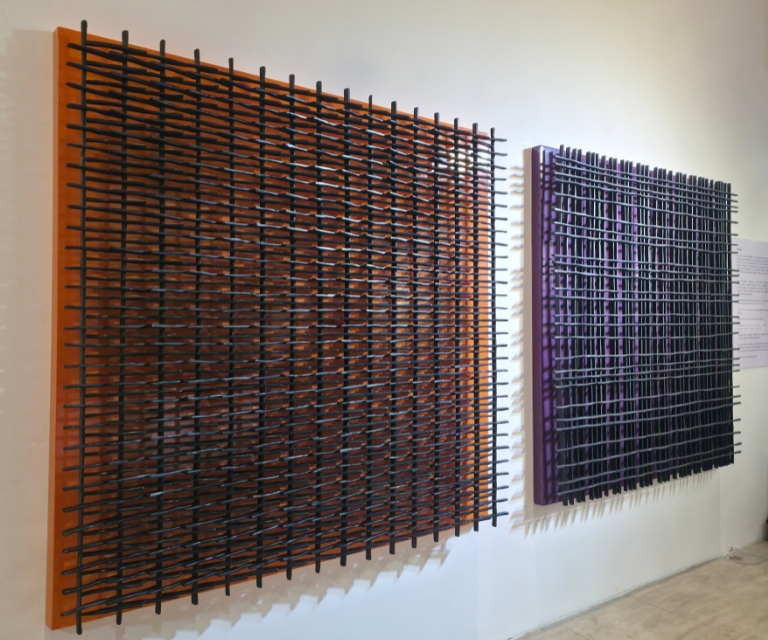
“I want to reintroduce the method of preserving wood by charring. Also, as an artist and a designer, I am particular with the finish that it brings to the wood—the texture, the colour, the black. Those are what I wanted to bring out of Yakisugi.”
The process itself becomes part of the artwork’s narrative. Rather than treating fire as something destructive, Naval presents it as an agent of preservation and renewal. Burnt wood carries rich textures and deep ebony tones, revealing that what appears damaged can, in fact, become stronger and more enduring. It’s a refreshing perspective in an era obsessed with perfection—proof that sometimes the “main character moment” comes after surviving the burn.
Material Harmony and Sacred Geometry
The exhibition extends beyond charred timber. Glass and galvanised steel complete the visual language, creating a dialogue between fragility, resilience, and industrial precision. Together, these materials embody the forces that continuously shape the natural world.
I was trying to express the elements in several ways,” Naval explains.
One, through colour. Two, I was trying to express the elements through geometric patterns like triangles, lines, and circles.”
Those geometric forms repeat throughout the exhibition, giving each piece a quiet rhythm. Triangles evoke mountains and flames. Circular forms hint at the sun, water, and cycles of renewal. Linear compositions suggest rain, wind, and movement. None of these symbols feel overly literal. Instead, they leave enough room for viewers to form their own interpretations—an approach that feels both contemporary and inviting.
Reframing the Natural Forces
Beyond aesthetics, Yakisugi offers a subtle shift in perspective. Naval hopes visitors leave with a renewed appreciation for the natural forces that often inspire anxiety.
I was trying to share to the viewers that these elements are day-to-day occurrences,” he says.
Some people fear experiencing so much rain or thunder. Through the show, I want them to view it in a positive way.”
Rather than dwelling on storms or uncertainty, the exhibition reframes them as essential parts of life. Fire transforms. Water cleanses and reshapes. Earth provides stability. Together, they become reminders that change is not always something to resist—it can also become the foundation for growth.
A Seamless Evolution from Design to Fine Art
That optimism resonates throughout the gallery. Even the darker works never feel heavy. Instead, they possess a calm confidence, balancing raw textures with refined craftsmanship. It is perhaps this duality that makes the exhibition especially compelling. Naval’s background as an acclaimed designer is unmistakable, yet these works move beyond function. They exist not to furnish a room but to hold space for reflection.
His transition into fine art also feels remarkably organic. Rather than abandoning his design principles, Naval builds upon them, demonstrating that material exploration can exist equally in collectible design and gallery practice. The result is an exhibition that feels cohesive, personal, and quietly ambitious.
A Timeless Declaration of Craftsmanship
In a cultural moment where audiences increasingly crave experiences that feel authentic over algorithmic, Yakisugi arrives with remarkable timing. It encourages visitors to unplug from the relentless scroll and spend a few moments with texture, light, shadow, and silence. No spectacle, no gimmicks—just thoughtfully crafted works that reward careful attention.
For a debut solo exhibition, Yakisugi is less an introduction than a declaration. It reveals an artist willing to let natural processes guide creation and to embrace imperfection as a form of beauty. Through fire, water, and earth, Milo Naval reminds us that transformation is rarely instant, but it is always worth witnessing.
Read more Stories on Simpol.ph
A Decade of Conrad Manila’s Canvas and Uncorked Creativity
IFVF 2026: Free Screenings Of Indie And Alt Films At Cubao This July!