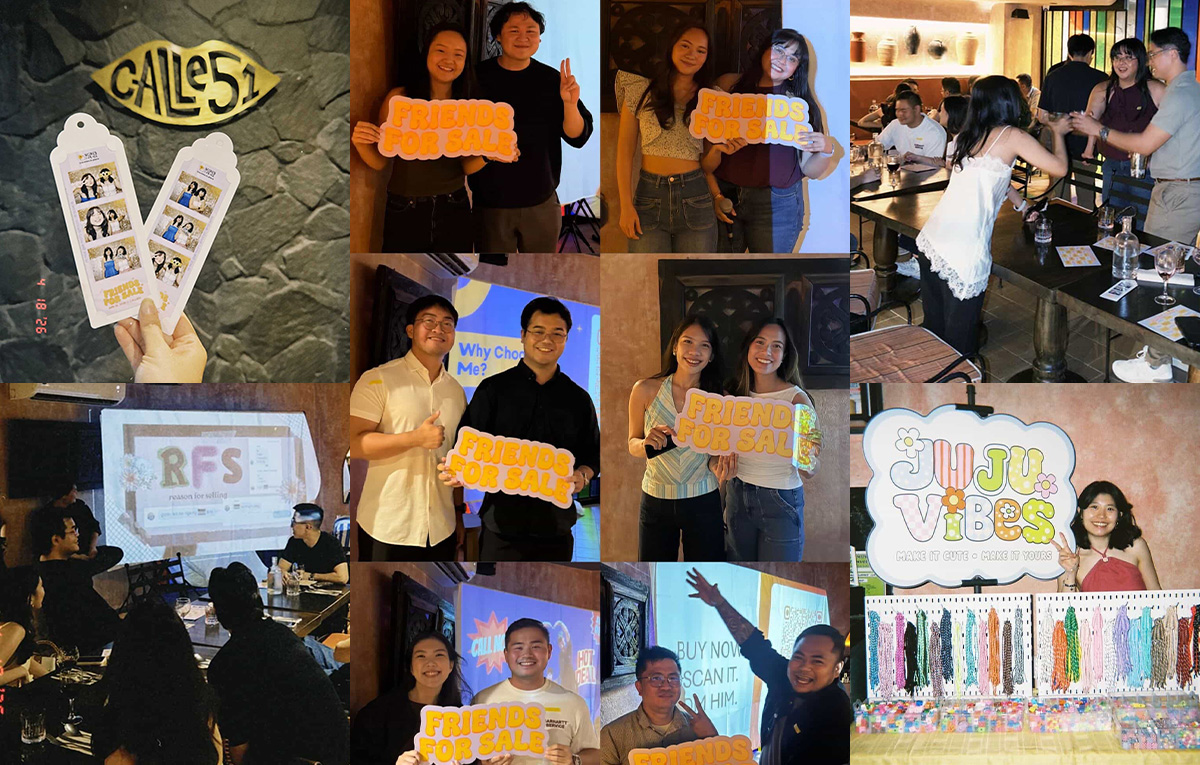
On a warm evening at Calle 51, a different kind of social ritual unfolded—one that replaced the quiet, individual choreography of dating apps with something louder, communal, and unexpectedly sincere. The occasion was “Friends for Sale,” the second event mounted by Scenes in Place, a growing series of gatherings designed to make meeting people feel less like chance and more like intention.
At first glance, the format bordered on theatrical. One by one, speakers stepped forward—not to talk about themselves, but to present someone else. Each pitch was equal parts testimonial and performance, a carefully constructed argument for why a particular friend should no longer be single.

The room responded in waves—laughter, applause, the occasional teasing remark. But beneath the humor was a distinct shift in tone from what has come to define modern dating. Here, attention was sustained, not swiped away. Strangers listened.
Scenes in Place is the project of Steffi Yuquimpo, who traces its origins to a familiar impulse: bringing people together.
I already loved organizing events and hosting friends,” she said.
What changed was scale—and purpose. What began as intimate gatherings has evolved into something more deliberate, shaped by a recognition that connection in adulthood often requires design.”
I’ve realized it’s so much harder to meet new people and form genuine friendships as adults,” she said.
Scenes in Place, then, is less about novelty than it is about creating the conditions for something many feel is missing. Each event is constructed as a kind of social architecture, where interaction is guided but not forced.
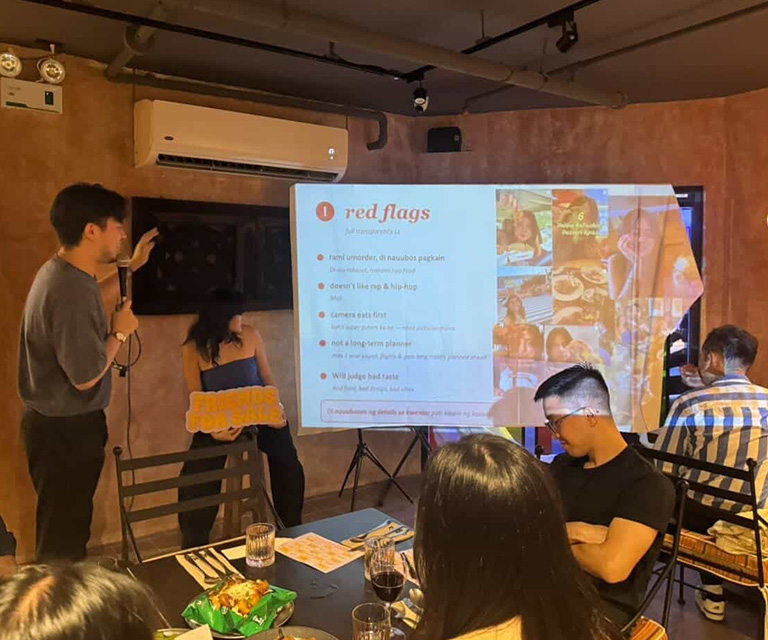
“Friends for Sale” reflects that approach with particular clarity. The idea, adapted in collaboration with Default Cafe Pub founder Bob Freking, builds on a concept that has quietly gained traction in Manila: let friends make the case. The result is a room in which vulnerability is distributed. No one stands alone.
There is, perhaps, a practical reason the format works.
Most people feel shy, or want to stay humble, when talking about themselves,” Yuquimpo said. “It’s hard to stand there and explain why you deserve not to be single.”
A friend, by contrast, can be both more generous and more specific—quick to praise, unafraid to embellish, and often attuned to qualities that might otherwise go unspoken.
The pitches themselves ranged in tone. Some leaned heavily into humor, offering playful disclaimers alongside endorsements. Others were more earnest, describing steadiness, kindness, or emotional intelligence in ways that felt unusually grounded. What unified them was perspective: each person onstage was being seen through someone else’s eyes.
If the presentations were structured, the atmosphere was not rigid. calle 51’s low lighting and close quarters lent the evening a sense of intimacy, even as the room filled with the ambient noise of anticipation. Conversations overlapped. Reactions rippled outward. The audience was not passive; it engaged, questioned, and occasionally challenged what it heard.
The appeal, in part, lies in contrast. Dating apps have expanded access while flattening interaction, producing what Yuquimpo described as a kind of fatigue.
You go through small talk with multiple people… and if it doesn’t work out, you go back to zero,” she said.
Events like this attempt to interrupt that cycle by compressing time and restoring context. A single introduction carries more weight when it is accompanied by narrative.
Yuquimpo refers to it as a “planned encounter,” a phrase that captures both the artificiality and the possibility of the setup. Everyone in the room arrives with a shared premise: they are open to meeting someone new. Within that framework, the usual ambiguities of social interaction—Who approaches first? What is this for?—become less pronounced.

When the final pitch concluded, the structure dissolved into something more familiar: mingling. Glasses were refilled, groups formed and re-formed, and the earlier performances began to translate into conversation. People approached one another not as complete strangers, but as partial acquaintances, already equipped with fragments of information.
It is in this transition that the event reveals its broader intention. Scenes in Place is not only about facilitating romantic connections, though those remain part of its appeal. It is also about reducing the friction that often prevents interaction from happening at all.
What I love most is seeing new friendships form and actually last beyond the event,” Yuquimpo said.
The response, she added, has been stronger than expected. Interest has grown quickly, though participation patterns reflect familiar dynamics; women tend to sign up earlier, while men take longer to commit. Even so, the turnout at calle51 suggested that curiosity alone is enough to fill a room.
There are, by Yuquimpo’s account, early indications that the format can produce more than momentary engagement. A connection from a previous event continues to develop, and there are signs that another may have begun here. She is cautious about drawing conclusions. The point is less to guarantee outcomes than to make them possible.
Within the broader vision of Scenes in Place, “Friends for Sale” represents one iteration of a larger idea: that connection can be cultivated through shared experience. Yuquimpo is already considering what comes next, including a supper club concept that would extend the network further by encouraging participants to bring someone new from their own circles.
For now, the scene at calle51 offers a glimpse of what that vision looks like in practice: a room arranged not just for dining, but for discovery. In place of algorithms, there are voices. In place of profiles, there are stories. And for a few hours, at least, the process of meeting someone new feels less like a transaction and more like an event.
Read more Stories on Simpol.ph
Finally, a Place Where the Night Doesn’t Feel Complicated
The Death of Romantic Valentine’s Day (and the Rise of Something Better)