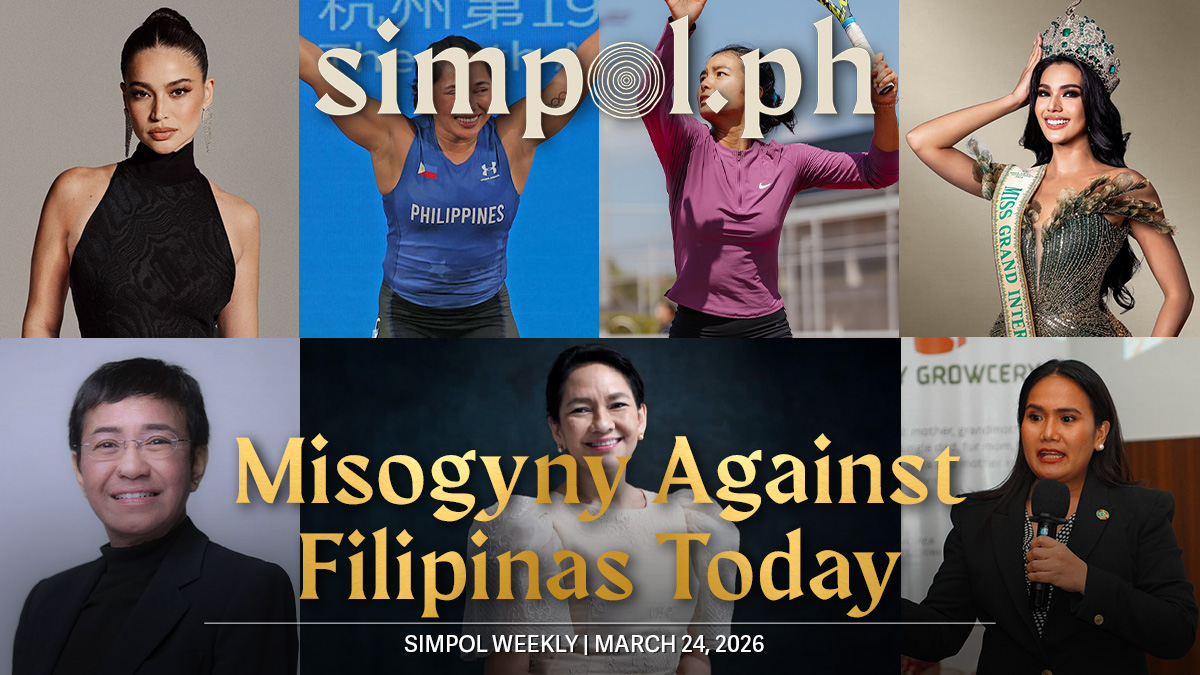
This story explores the journey of a Modern Filipina breaking the Maria Clara mold.
If there is something women experience on a daily basis, it is definitely misogyny. Historically and sociologically, extreme misogyny often manifests as a blend of traditional patriarchal “macho” culture and modern digital or political aggression. Notably, these issues are confronted by the Modern Filipina breaking the Maria Clara mold, who challenges such norms.
While the Philippines ranks high in global gender equality ratings, these experiences highlight the systemic, rampant, and often violent nature of the prejudice that women face. That is just how this archipelago was built for women—through injustice and inequity.
Filipinas have consistently been part of these phenomena: slut-shaming, red-tagging, sex-tape fabrication, and a daily dose of dehumanizing remarks both online and offline. As recently as March 2026, the Philippine Commission on Women (PCW) issued statements condemning sexist remarks from a public official, reinforcing a culture in which objectifying women is seen as “just a joke.”
“What happened to me isn’t rare. It happens to women every day… in offices, in group chats, in rooms where men think no one is listening, or worse, in rooms where they know everyone is and simply don’t care,” Anne Curtis wrote in a statement posted online.
The women of this nation have evolved through chapters of insufferable experiences rooted in judgment, doubt, inequality, and injustice. This is not just the origin of Filipinas’ fate in this country but also the unfortunate root of ceaseless misogyny.

Nostalgia of Maria Clara: Sociological Evolution Turned “Social Cage”
In Dr. José Rizal’s seminal novel Noli Me Tangere (1887), Maria Clara de los Santos y Alba is the primary female protagonist during the Spanish colonial period. She is initially presented as the daughter of Capitán Tiago and Doña Pía Alba. Later, it is revealed that she is the biological daughter of the Spanish friar Padre Dámaso—a plot point Rizal used to symbolize the “bastardization” of the Philippines under Spanish friar rule.
Maria Clara was known to possess the qualities of the “ideal woman”: fair-skinned, demure, religious, and fiercely loyal. In reality, Rizal intended Maria Clara to symbolize a victim under colonial and clerical abuse. Over time, the Spanish and American colonial educational systems repurposed her as a moral standard for Filipinas.
Filipinas were taught to emulate Maria Clara. This meant being mahinhin (modest), matiisin (long-suffering), and sunud-sunuran (submissive) toward the patriarchal system. According to Jean-Noël Sanchez in a paper on Rizal’s Letter to the Women of Malolos (1889):
“Women were then supposed to maintain themselves in their suffering role of loving mothers, sisters, and wives of the male heroes entitled with the virile mission of nation building. They were supposed to be inspirers, caring providers, not instigators…”
Sociologically, this paradigm functioned as a “social cage.” By placing women on a pedestal of “purity,” patriarchal society effectively barred them from leadership, vocal dissent, and sexual autonomy. Whenever a woman was not a Maria Clara, society labeled her “fallen” or “loose.”

Revolutionized Women: Modern Filipina Breaking the Mold
The “Modern Filipina” is a real-life deconstruction of the Maria Clara mold. While the traditional archetype was built on restrictions—staying inside homes, churches, and the veil of modesty—the Modern Filipina is defined by diversification and liberation, taking up space in boardrooms, the digital world, and the political arena. Likewise, the Modern Filipina breaking the Maria Clara mold defies conventions by embracing her identity in all areas of society.
Modern Filipinas are unafraid to assert themselves—stating clearly what they want, what they do not deserve, and what they will not tolerate. These behaviors exemplify how women today are breaking the mold once reserved for Maria Clara. In addition, the Modern Filipina breaking the Maria Clara mold inspires others to pursue freedom and self-expression.

Rewriting Women: Binding the Shadow Into the Light
The Modern Filipina is not necessarily the complete opposite of Maria Clara. She is a woman who claims the right to choose which parts of that heritage to keep and which to discard. She is the long-overdue response to centuries of being told to remain voiceless despite having every reason to speak up. Furthermore, the Modern Filipina breaking the Maria Clara mold signals a new era for Philippine women.
Culturally, Modern Filipinas still feel the lingering guilt and challenges of breaking the Maria Clara mold. Many carry a “Maria Clara shadow”—a feeling of being “too much” or “not feminine enough” when prioritizing their own needs over tradition. In a still very patriarchal society, innovative women are often misunderstood and judged for simply taking up space.
Records show that these sacrifices have produced remarkable achievements. From grassroots activists to high-ranking government officials, business leaders, educators, healthcare professionals, performers, and digital media influencers, the Modern Filipina uses her platform to challenge systemic misogyny.
She has evolved from being an inspiration for heroes—as Maria Clara was for Ibarra—to being the hero of her own story.
A safer space for women is being built through solidarity and presence. When women occupy tables to work, lead boardrooms, or speak publicly, they collectively signal that a woman’s place is wherever she chooses to be.
By balancing the grace of Maria Clara with the grit of the Modern Filipina, a blueprint emerges for younger women: they can redefine a landscape rooted in misogyny into a foundation for growth, opportunity, and agency—unapologetically.
Babae ka, hindi babae lang.
Read more Stories on Simpol.ph
Janine Gutierrez and Anne Curtis: Using Their Voices to Champion Respect This Women’s Month
Mental Health Matters: Women Advocates Leading the Conversation