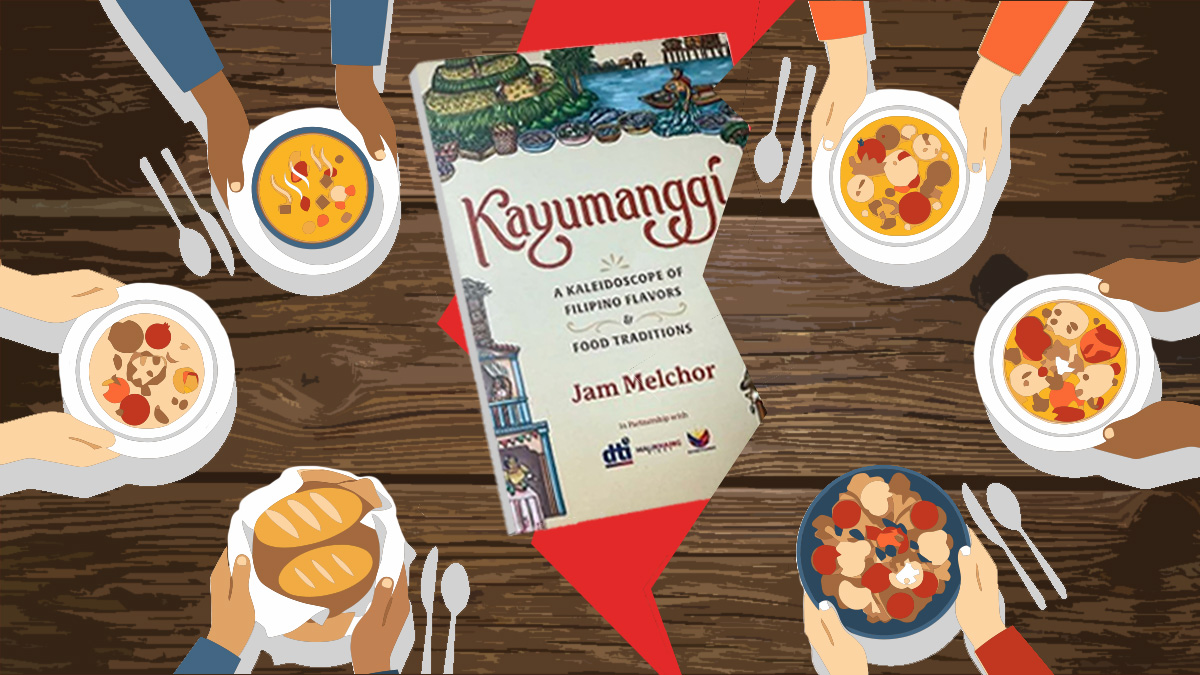
Imagine you’re at a potluck. Recently, the Kayumanggi cookbook controversy in the Philippines has sparked widespread discussion about food and culture.
Someone brings a dish—a big one, proudly made, enough for everyone. You take a bite, and something is off. Not just slightly. The seasoning is off, the story behind it is not accurate, and the ingredient on the label is not what is in the bowl. You know this because you’ve sat at the tables where this dish was born. You’ve spoken to the Lolas who make it. You’ve traced it back to its source.
What do you do?
Do you say something? Or do you smile, nod, and let the wrong version become everyone’s memory of that dish?
This is not hypothetical. It is, more or less, what happened with Kayumanggi: A Kaleidoscope of Filipino Flavors and Cooking Traditions—a cookbook funded by the Department of Trade and Industry (DTI), released during Filipino Food Month 2025, later awarded, and now at the center of a cyberlibel case.
Food heritage documentarian John Sherwin Felix, founder of Lokalpedia, received a copy. He identified more than a dozen errors—cultural, scientific, and factual. Among them: tawilis, the freshwater sardine found only in Taal Lake and classified as endangered since 2018, described in the book as commonly found in “freshwater lakes and rivers in the Philippines.” He emailed the DTI. There was no response. He then posted about it publicly. The author, Jam Melchor, filed a cyberlibel complaint.
And just like that, the potluck turned into a battlefield.
What troubles me is not only the case itself, but what it reveals about the space we have built around Philippine cuisine.
For years, we have repeated a familiar narrative: that Filipino food is having its moment, that the world is finally paying attention, that we are on the edge of something—a story built on passion, advocacy, and heritage, presented to a global audience.
And so the table has filled.
Because the cuisine remains fluid, accessible, and still largely undocumented at scale, the barrier to entry is low. Anyone can claim love for it and be welcomed as a steward. Passion becomes the credential.
But passion without rigor is not preservation. It is performance.
The Kayumanggi case is no longer just a legal dispute. It is a mirror.
This is a government-funded publication, meant to document and honor regional culinary traditions—meant, at the very least, to be accurate enough that communities can recognize themselves in it. When it contains errors, those communities deserve correction. That is not an attack. That is the work.
The silence from the DTI is its own answer: no acknowledgment, no errata, no correction—only an award and a lawsuit against the person who raised the concern.
Even the most careful publications have lapses in a first edition. That is not unusual. It is why errata exist. It is why revisions are part of the life of a book. This, at its core, is an easy fix—if the goal is to get it right.
The project is not fundamentally a failure. It was simply not perfect—yet.
This did not need to become a case. A careful correction, a clear erratum, and a revised edition would have addressed the issue. Instead, energy that could have gone into getting the work right has been spent elsewhere.
But the mirror does not face only one direction.
We are also living in a space where critique and performance often wear the same clothes. Authority is flattened. The same voice that corrects a cookbook today may dismantle policy tomorrow and review a restaurant the next—all with equal confidence. Clout becomes currency, and currency becomes influence.
In that space, even necessary critique can begin to drift toward theater.
So let us be clear: Felix was right to raise the errors. A publicly funded cultural document with inaccuracies—especially involving endangered species and regional knowledge—must be corrected, publicly and without apology.
But the deeper question is not only who was right.
It is this: What kind of table are we setting?
At a proper potluck, someone brings a dish that is not quite right. Someone else says—gently or directly—this is not how this is made. The cook may resist at first. That is human. But if the gathering is what it claims to be—a space for sharing, learning, and honoring—then the correction is received. The dish improves. The table deepens.
That is what critique within a community of care looks like.
What we are seeing now is something else: a space where the instinct is not to correct and continue, but to defend and escalate; where pointing out an error in a public document becomes grounds for a case carrying the weight of prison; where being wrong is no longer followed by revision, but by litigation.
Both of them belong at this table. That is not a sentimental statement—it is a practical one. The work of documenting, preserving, and elevating Philippine cuisine is vast and still largely unfinished. We need everyone who can do it seriously. When two people from the same community move to disenfranchise each other, the rest of us are left in an impossible position: forced to choose sides at a table that was never meant for choosing sides. And whichever side prevails, we lose someone who could have contributed to the work still ahead of us.
This is why the leaders and elders of this community must speak—not to referee, but to call for reconciliation. Not because the errors do not matter, but because the table matters more. If we intend to keep it whole, someone with standing must say so clearly.
And while all of this unfolds—in headlines, comment sections, and declarations of solidarity—the tawilis remains in Taal Lake, endangered, waiting for someone to get it right.
We Filipinos have a deep appetite for drama. That is part of why this case has gained such traction: a lawsuit over a cookbook, a heritage advocate facing prison, sides forming in real time. It has all the elements of spectacle.
Enough.
There are scholars, farmers, market women, and cooks—many without platforms—who have spent their lives building the foundation we now argue over. They did not do this for visibility. They did it because the food, and the people behind it deserved to be represented truthfully. That work remains unfinished. This moment does not help complete it.
We did not inherit this cuisine to improvise it carelessly.
Regardless of how this case resolves, its imprint on the public record will linger.
I will say it plainly: the best outcome is for both parties to step back—to choose to be the kind of Filipinos we actually need right now. Not the kind who fight over who owns the story of a dish, but the kind who make sure it is told right and shared well.
Because in the end, this was never about a book or a post.
It was about the table.
And whether we still remember how to keep it a place where truth is served, correction is welcome, and everyone leaves nourished—with dignity intact.
Read more Stories on Simpol.ph
The Maya Kitchen and FEATR Champion Filipino Food Heritage Through Culinary Revival
First Northern Mindanao Food and Wine Festival Launches in Cagayan de Oro