Kiki the cat is being interviewed about how much she loves her mommy. In a tiny, earnest voice, she explains that she waits by the door, sleeps beside her at night, and forgives her even when dinner is served late. The video is funny, affectionate, and calibrated just enough to feel worth sharing.
Then Lily appears. She, too, is interviewed about her mommy. The setting is different, the voice is different, and the jokes have changed, but the emotional structure remains familiar. Soon there is Marie, answering nearly the same questions and delivering nearly the same message: pets love their humans more deeply than we sometimes realize.
Why do we continue watching? Perhaps because each version feels new even when the idea is not. Artificial intelligence makes this repetition almost limitless. It can generate endless variations of a successful format, each adjusted to look fresh, familiar, and personally appealing.
AI may solve the old problem of content scarcity. It may also create a new problem: an abundance so frictionless that meaning itself becomes scarce.
The Age of Gatekeepers
Content scarcity did not mean that people lacked stories, songs, images, or ideas. Human beings have always created culture. The scarcity lay in production and distribution.
For most of modern history, publishing a book required access to a publisher, printer, and distribution network. Producing a film required cameras, actors, crews, editors, and considerable financing. Recording music required equipment, studio time, and a company willing to distribute the finished work. Television and radio had limited airtime. Newspapers had limited pages. Bookstores had limited shelf space.
These limits placed cultural power in the hands of relatively few institutions. Publishers, broadcasters, studios, and record labels decided which stories deserved investment and which audiences were worth reaching. These gatekeepers often supported excellent work, but they also excluded many voices. Regional perspectives, minority languages, specialized interests, and unconventional forms could be dismissed as too narrow, unfamiliar, or insufficiently profitable.
Generative AI’s Inevitable Rise
Digital platforms weakened some of those barriers. A writer could publish a blog, a musician could upload a song, and a filmmaker could distribute a video without first obtaining institutional approval. Generative AI pushes this democratization further. It lowers the cost of writing, editing, translation, illustration, animation, voice production, and video creation. A single person can now attempt projects that once required an entire creative team.
That is why Kiki, Lily, and Marie can all speak. Each cat no longer needs a separate production crew, voice actor, editor, and scriptwriter. A creator can repeat the format quickly, changing the animal, dialogue, setting, and emotional details.
This abundance can be beneficial. More people can participate in public culture. Educational materials can be translated and adapted for specific communities. Niche groups can receive content designed for their interests and languages. AI-assisted tools may also help marginalized storytellers produce and distribute work for audiences they previously struggled to reach.
But the old cultural problem was that too little content could be produced and circulated. The new problem may be that content can be generated without practical limit.
Same Feeling, Different Cats
One concern is that limitless, personalized content may weaken shared cultural experiences.
Mass media once gave large audiences common reference points. Families watched the same evening programs. Entire communities discussed the same television finale, blockbuster film, hit song, or front-page story. Even people who disliked a particular work often knew enough about it to participate in the conversation.
Personalized media has already begun fragmenting this shared environment. Streaming services, social platforms, and recommendation algorithms give different users increasingly different cultural diets. Generative AI could take this much further. Instead of recommending different existing videos to different viewers, it may eventually generate a different video for each of them.
One person receives Kiki. Another sees Lily. A third watches Marie. The cats look different, speak differently, and live in different homes. Their interviews may be adjusted to match each viewer’s preferred humour, language, pacing, and emotional tone.
At first glance, this appears to dissolve shared culture. How can people discuss the same media if they are no longer watching the same thing?
But perhaps shared culture does not always require identical content.
Kiki, Lily, and Marie may be different characters, yet their videos express the same underlying ideas. Pets love their humans. Animals become amusing when given human voices and motivations. Affection becomes even more moving when presented through a playful interview.
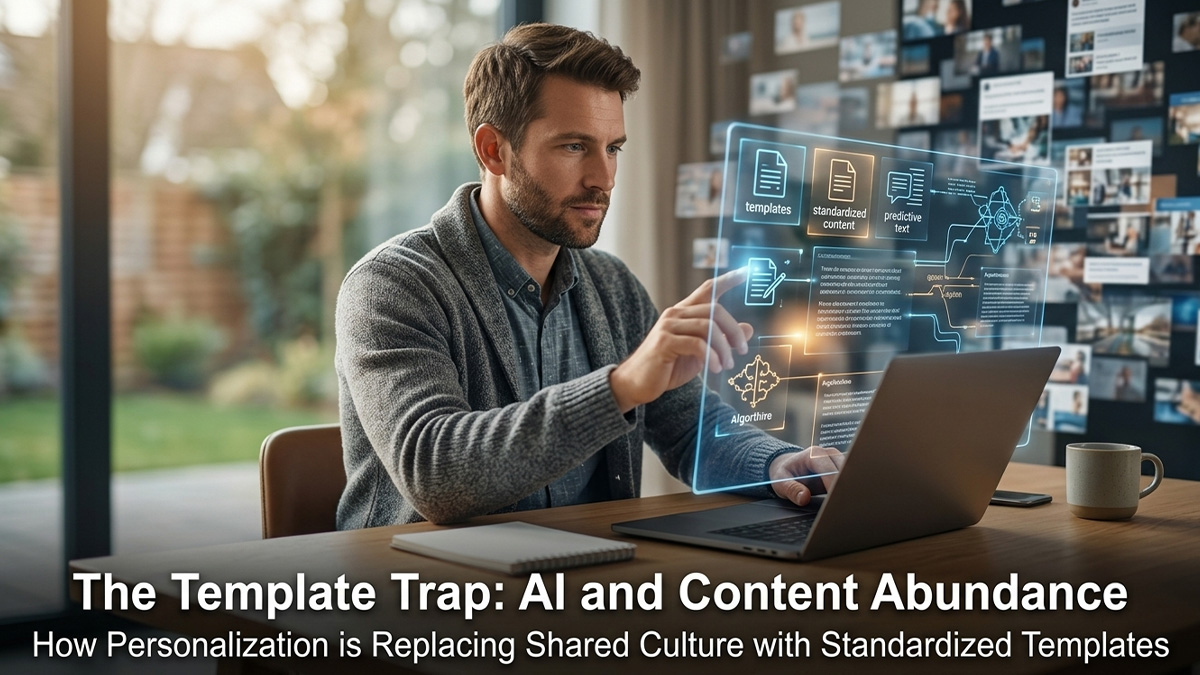
The viewers may not share the same video, but they recognize the same format, emotional structure, and cultural premise. Shared culture may therefore shift from shared texts to shared templates.
Individualized Content vs. Standardized Content
This creates a paradox. The surface content becomes highly individualized, while the underlying ideas become increasingly standardized. Everyone receives something that appears unique, yet everyone may still be consuming variations of the same story.
Content abundance might therefore weaken common reference points without producing genuine cultural diversity. AI systems trained to maximize attention may repeatedly reproduce familiar emotional formulas because those formulas are predictable, safe, and effective. Different cats, different voices, different backgrounds—but the same joke, the same sentiment, and the same carefully engineered reaction.
We already see early signals of this shift on platforms flooded with slight variations of the same trending short-form video format, many of them fully synthetic. The danger is not simply that people will live in separate cultural worlds. It is that those worlds may look different while remaining structurally identical.
On a cognitive level, this matters. Shared cultural moments once served as anchors for memory and collective sense-making. When every viewer receives a slightly different version of the same emotional beat, those anchors become harder to locate. Attention may be captured more easily, but the deeper work of building shared understanding grows more difficult.
From Curation to Creation
Today, recommendation systems choose from content that already exists. YouTube recommends a video. Spotify selects a song. Netflix suggests a film.
The next stage may be a generation system. Instead of searching for the perfect cat interview, the platform could create one in real time: a new cat, a new voice, a new joke, and a new story designed specifically for one viewer.
This could make entertainment more accessible, education more adaptive, and cultural production more inclusive. It could also produce an endless stream of AI slop: cheap, repetitive, minimally considered material optimized mainly to keep people watching.
AI slop is not simply content made with artificial intelligence. It is content produced without sufficient purpose, judgment, originality, or care. Its primary function is circulation rather than meaning.
The future scarcity may therefore no longer be content. It may be attention, trust, shared experience, and significance.
The challenge will not be finding something to watch. It will be deciding whether the next cat engineered for our screen was ever worth making.
Read more Stories on Simpol.ph
The One-Person Studio: Artificial Intelligence and Content Creation