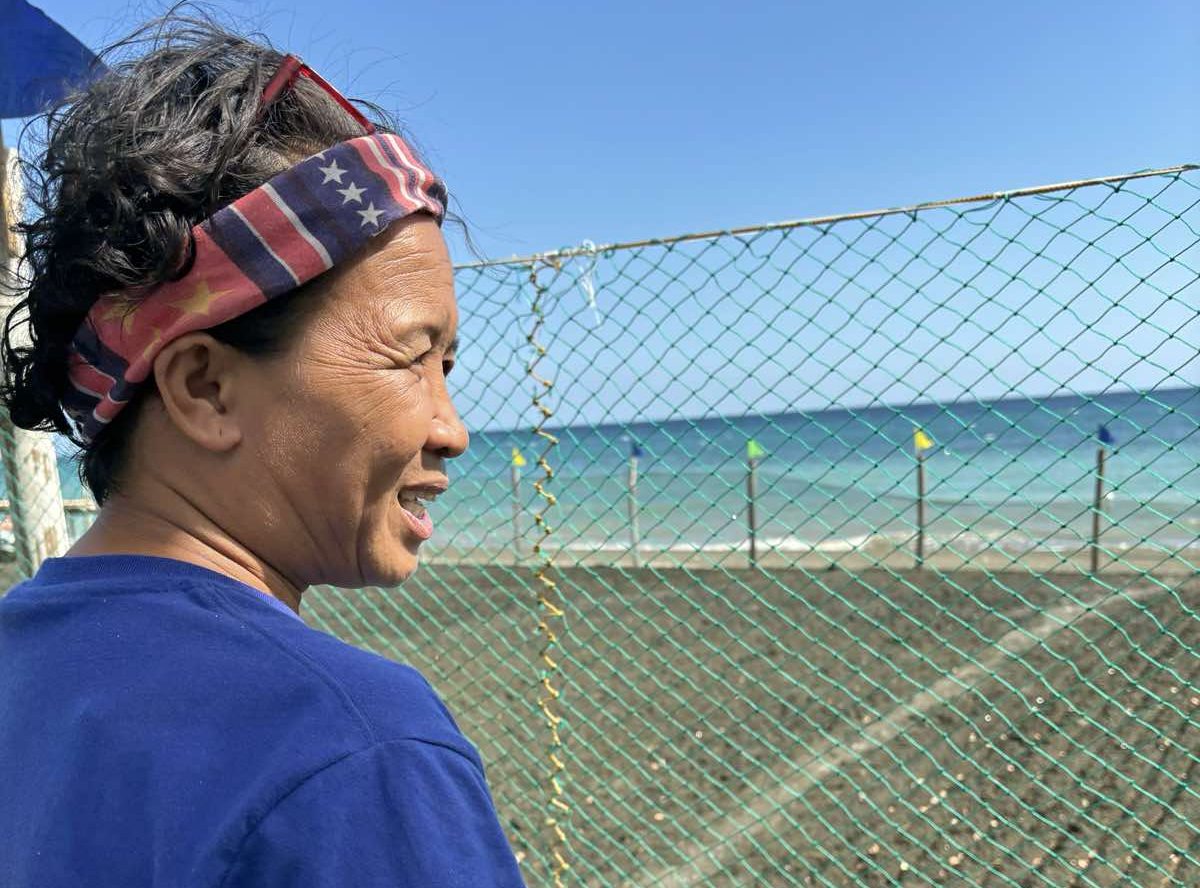
On a quiet stretch of shoreline in Miag-ao, known for its signature Miag-ao artisanal sea salt, salt crystals glint on bamboo slats, catching the morning light.
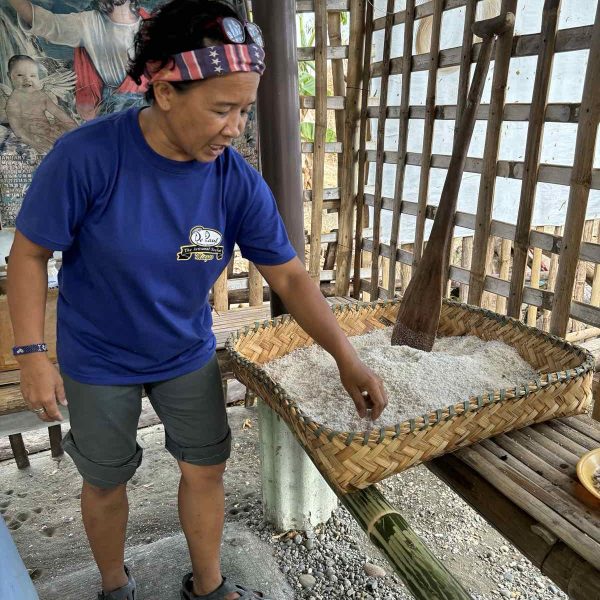
A petite woman moves with practiced rhythm—wooden paddle in one hand, a basket of boiled saba in the other. She pauses to smile, offering both hospitality and history in a single gesture. This is Lorlie Paguntalan Noblezada, and this is her salt story.
Miag-ao, a charming town nestled between Iloilo City and Antique, hosts more than 68,000 residents. It proudly features the Santo Tomas de Villanueva Parish Church—one of only four Baroque churches in the Philippines declared a UNESCO World Heritage Site. Later, the entire town gained recognition as a UNESCO World Heritage City and joined the Organization of World Heritage Cities (OWHC).

Beyond its iconic church, Miag-ao also champions a vibrant textile tradition. It produces the hablon and patadyong—colorful, checkered fabrics often worn during Linggo ng Wika. Today, these textiles evolve into bold, stylish pieces worn by modern Filipinas.
Years ago, while searching for local weaves, I met a Miag-ao weaver who once supplied fabric to a French designer for a bag called “The Manilacaba.” With leftover cloth, she stitched a small vanity case, which I quickly bought—and still use today. Like the hablon itself, Miag-ao’s salt-making tradition once faded into near-obscurity—until one woman brought it back to life.
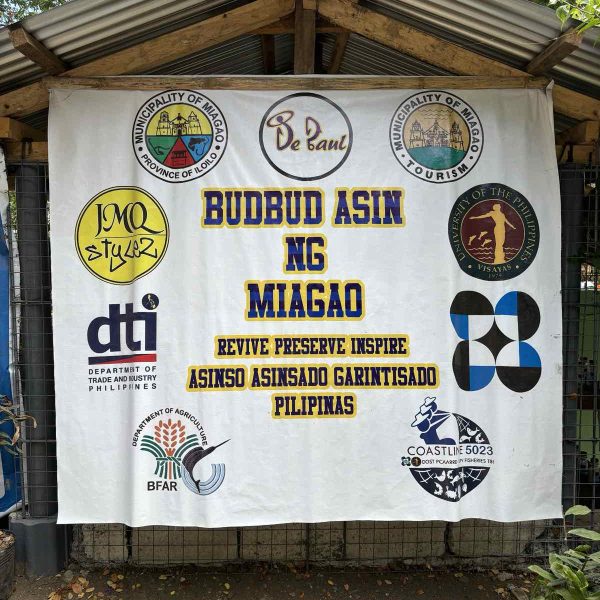
Just past the municipal hall, a coastal treasure quietly thrives. De Paul Artisanal Salt Manufacturing sits behind a wooden fence and a flapping tarpaulin, opening onto a serene beach.
There, Lorlie Paguntalan Noblezada welcomes visitors. A social worker by profession, she now proudly calls herself the Asindera of Miag-ao.
In 2018, Lorlie revived a fading legacy—Miag-ao artisanal sea salt, locally known as budbud asin. This centuries-old technique, which began in 1823, had nearly vanished by the 1980s as commercial salt-making replaced traditional methods to meet the demand for speed and mass production.
But Lorlie believed in tradition. With her husband Rizalde and their nine children, she rebuilt the salt-making process from scratch. With support from DSWD’s Bureau of Women’s Welfare and KALIPI, she steadily brought the craft back to life.
Back in 1995, the government passed a law known as the ASIN Law—meant to address iodine deficiency by requiring all salt sold commercially to be iodized. While well-intentioned, this law effectively shut out traditional salt-makerswho couldn’t afford the equipment or meet the standards of mass production. What was once a proud local product quickly disappeared from markets, not just here in Miag-ao but in places like Pangasinan, Zambales, Mindoro, and even the remote shores of Palawan. Many stopped, gave up, or quietly moved on.
Thankfully, the law was recently repealed, giving artisanal salt-makers a new lease on life. Lorlie’s revival of Miag-ao artisanal sea salt came just in time.
“This salt helped send my kids to college,” Lorlie tells us. “It’s more than food—it’s family.”

We discovered budbud asin while sourcing local ingredients for LaMeza Ilonggo. A friend from Miag-ao pointed us toward Lorlie. Unsure where to go, we used the church as our only landmark.
After a few wrong turns, our friend met us on the highway and guided us to Lorlie.
She welcomed us with open arms and led us to a beachfront lined with bamboo slats. There, she showed us how Miag-ao artisanal sea salt comes to life.
To Lorlie, budbud asin is not just a method. It’s memory—poured, filtered, and formed under the sun.
She learned it from watching elders move sand like rice, brushing seawater over it in careful, practiced motions. The process was rhythmic, almost meditative. For days, saltwater would be poured over fine white sand, then left to dry under the coastal sun. Each step was quiet work, done barefoot, hands moving with the tide.
Once the sand had absorbed enough salt, Lorlie and her family would extract the brine by pouring fresh seawater over it, collecting the mineral-rich liquid in bamboo tubes. There, under the heat of the Miag-ao sun, the water would slowly evaporate—leaving behind golden crystals that tasted of sea and wind and time.
This is budbud asin. A salt-making tradition that dates back over a century. Long before modern factories. Long before table salt came in plastic bags and paper boxes. It’s slow, labor-intensive, and deeply local—rooted in the land, the weather, and the wisdom of those who came before.
For Lorlie, every batch is a form of resistance. Against forgetting. Against convenience. Against the slow erasure of crafts passed down from generation to generation.
“This salt helped send my kids to school,” she says. “It’s our life.”
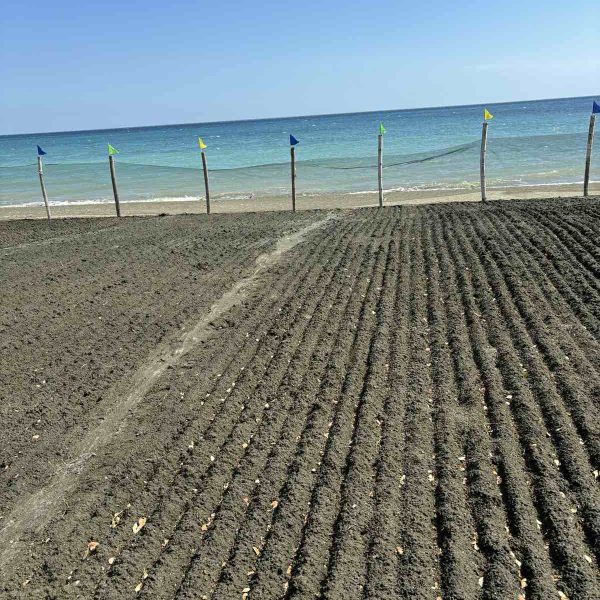
Budbud asin is no ordinary salt. Its beauty lies in the patience and tradition behind every grain. At the De Paul workshop, the process starts early. Lorlie harvests seawater using hollow bamboo poles, carefully carrying each one across the sand—each pole holding the essence of the nearby sea.
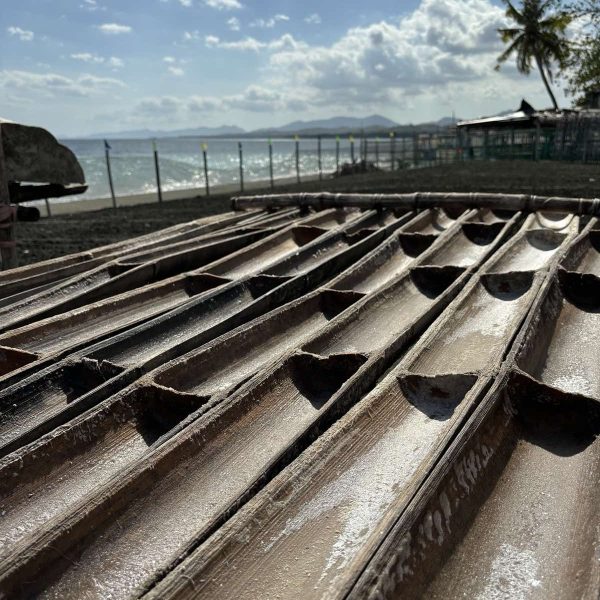
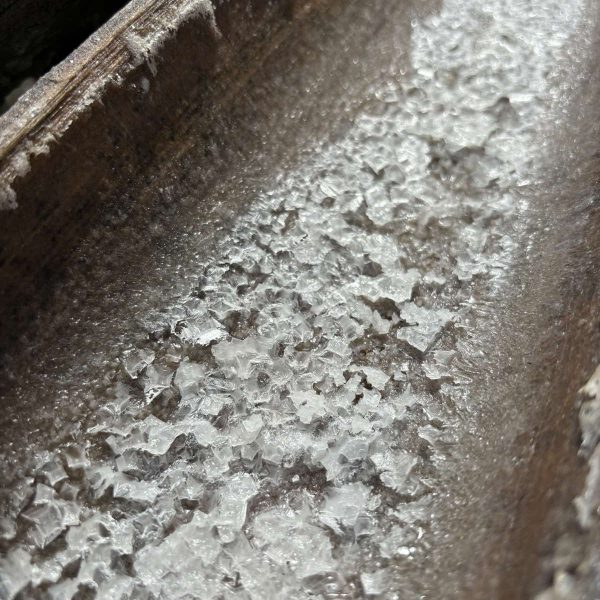
She sprinkles the water over sand using the “budbud” method—the Kinaray-a word for sprinkle—which gives the salt its name. The sand absorbs the brine, and the seawater begins its transformation. Lorlie filters the concentrated liquid and pours it onto bamboo slats under the sun, where it dries slowly and naturally.
The next steps blend science and art. Sunlight draws out the moisture, crystals emerge, and Lorlie hand-roasts the results. The final product? A clean, mineral-rich, handmade salt that carries the soul of Miag-ao artisanal sea salt.
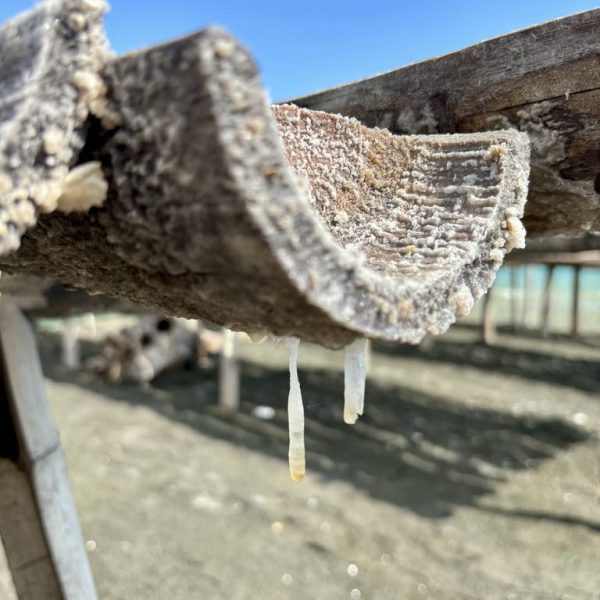
The heat shimmers on the shore as Lorlie lifts a full bamboo tube with ease. Brine spills over the sand in gentle arcs. Nearby, a kettle simmers and the smell of roasted salt drifts through the salt shack’s open slats.
The process begins with hollow bamboo poles punctured at one end to collect seawater. Lorlie sprinkles the water over prepared sand using the bamboo, starting the careful process that transforms seawater into Miag-ao artisanal sea salt. The sand absorbs the brine, which she then filters and pours onto split bamboo slats to dry.
This is slow, physical work. Each seawater-filled pole weighs about fifty pounds. A wooden rake helps Lorlie spread the brine evenly.
As the water evaporates, salt crystals appear. These crystals become the prized Miag-ao artisanal sea salt, treasured by chefs and home cooks alike. Lorlie filters and roasts them by hand, producing pure, clean, flavorful salt.
Though the method is age-old, Lorlie works with energy and joy, offering stories—and snacks—along the way.
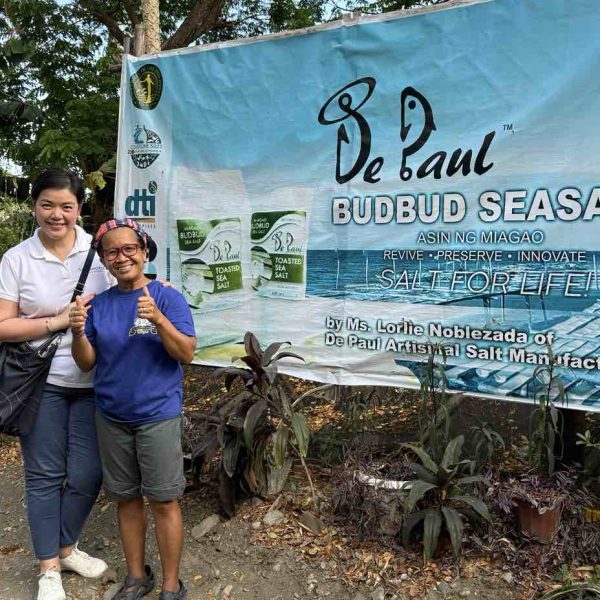
Lorlie’s mission is deeply personal. She began this work to support her children’s education. Four of her nine children have already graduated from college. She continues working to help the remaining five.
One of her children once said, “We didn’t always understand why Mom worked so hard. But now, we see it—in every pouch of salt, there’s a piece of her story.”
But Lorlie dreams beyond her own family. She wants to organize local women, teach them budbud-making, and preserve Miag-ao’s salt-making heritage.
She named her business after St. Vincent de Paul, embracing his values of compassion and service.
Today, Lorlie collaborates with UP Visayas, Coastline 5023 FTBI, DTI, DOST, BFAR, and her local government. Together, they modernize her operations—from plastic containers to resealable pouches, branded grinders, and lemongrass-infused sea salt.
Her products now appear in Richmonde Hotel Iloilo, Muelle Deli Restaurant, and other culinary establishments. Lorlie manages deliveries, collections, and promotions herself. She joins trade fairs, trains local women, and speaks at public forums—all to preserve Miag-ao artisanal sea salt.
With growing support from the community and partners, De Paul continues to expand. Lorlie plans to upgrade the salt-roasting shed, build public restrooms, and create a visitor display area. She envisions cultural and culinary tours that invite guests to experience Miag-ao artisanal sea salt up close.
She doesn’t chase fame. Her mission is to protect the tradition of Miag-ao artisanal sea salt, uplift women, and live a life rooted in faith, love, and resilience.
“I don’t need to be famous,” Lorlie says. “I just want people to taste what we’ve almost forgotten.”
In a world that rushes forward, Lorlie’s salt-making calls us to slow down. Her work proves that the best flavors—and the richest stories—come from hands that remember.
For me, Miag-ao didn’t just offer salt—it reminded me that quiet, handmade things still carry the loudest meaning.
Would you like to visit or order Lorlie’s salt? Reach out to De Paul Artisanal Salt on Facebook and discover the flavor of heritage.
You may also want to explore LaMeza Ilonggo, where her salt is featured in select dishes, or learn more about the Slow Food community through Slow Food Philippines.
More from Iloilo, only on Simpol.ph:
-
Ilonggo Flavors Take the Spotlight: Iloilo City Launches National Culinary Heritage Book — A deep dive into Gastronomic Expressions of Our City, Iloilo, a 244-page celebration of Ilonggo recipes, culture, and geography.
-
Filipino Tablea Chocolate: How One Woman in Iloilo Is Reviving a Heritage Tradition — Meet the artisan in Cabatuan bringing traditional cacao tablea back to life.
-
Secrets We Refuse to Keep: That Green House in Jaro — A charming feature on Hinolan’s barquillos, a three-generation Ilonggo wafer legacy.
-
Inside Iloilo’s Soulful Kitchens: The City That Feeds Hearts — Our flagship feature on Iloilo’s UNESCO Creative City designation and its vibrant food scene.