If you have ever braved the soul-crushing expanse of the EDSA commute, your eyes have likely locked onto it. A hulking, imposing fortress of raw, geometric concrete. It looks less like a place to grab a bucket of chicken, but more like a post-apocalyptic bunker designed to survive a nuclear attack.
This is Manila’s famous “Brutalist KFC” near Greenhills. For years, commuter folklore joked that it was a hyper-secure facility or a government vault. In reality, it is one of the city’s most iconic, polarizing pieces of mid-century architecture.
Officially known as the Pacific Office Machines Building, the story of the man who dreamed it up is just as fascinating as the structure itself.

The Master Builder: Engr. Antonio Heredia
The creative mind behind this geometric creation was Antonio Heredia. An elusive but brilliant post-war Filipino architect and civil engineer.
Heredia belonged to a rare breed of builders in the mid-20th century. Holding degrees in both design and engineering, he didn’t just care about what a structure looked like. He was obsessed with how it stood up.
While his contemporaries focused on pretty facades, Heredia was calculating how to clear massive internal spaces without using obstructive columns. This is through pioneering advanced structural techniques like post-tensioning in local construction.
The Art of Brutalism “Béton brut”
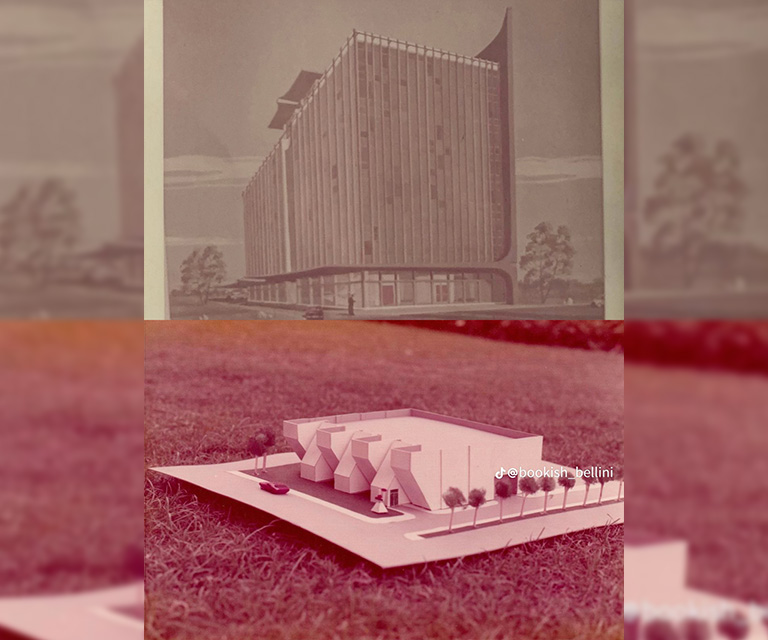
Beneath his rigid engineering lived an avant-garde artistic mind. Heredia didn’t look to classic European estates for inspiration. He then looked at modern technology. The building’s iconic, oddly sloping, jagged concrete blocks were actually designed to mimic the angular, mechanical forms of vintage typewriters.
When it rose in the early 1960s, EDSA wasn’t the dense, billboard-choked highway it is today. Heredia’s typewriter-inspired fortress stood out as a bold, futuristic monument of Brutalism. An architectural style defined by raw, unpainted concrete (béton brut), heavy geometric forms, and absolute structural honesty.
Built Like a Battleship
Heredia’s dual mastery meant his buildings were notoriously over-engineered. He didn’t just build for aesthetic impact, he built for survival.
According to family accounts, Heredia designed his projects with a level of structural integrity that far exceeded the safety codes of the era. While typical buildings of the time were engineered to withstand moderate tremors, Heredia’s concrete fortresses were built to survive Richter scale 8 earthquakes.
It’s the reason why, more than 60 years later, while the rest of the highway has been torn down, remodeled, and replaced by glass malls, Heredia’s creation hasn’t grown a single structural wrinkle. It is, quite literally, built to endure, and last.

From Typewriters to Gravy Boats
The building was originally commissioned to house the Pacific Office Machines company, which explains the typewriter design language. Over the decades, it seamlessly shifted identities, operating as a supermarket and later an automotive association headquarters.
When KFC eventually took over the ground floor, it presented a hilarious design challenge. Brutalist buildings are famous for being solid, impenetrable masses. But a fast-food joint needs a welcoming storefront and a drive-thru. To make it work, contractors literally had to blast and carve a front entrance out of several feet of solid, unyielding post-war concrete.
Today, it stands as a beautiful anomaly. The bright red fast-food branding creates a surreal contrast against Heredia’s moody, dramatic concrete tiers. This is a testament that some of the greatest and most honest architecture doesn’t need to be demolished to stay relevant. Sometimes, it just needs a little creativity and some spice.
Read more Stories on Simpol.ph
How Maris Racal Rewrote Her Own Script with “Sunshine”
How a Studio at Matino Street became the heartbeat of Manila’s Analog Revival