I discussed in an episode of my other op-ed podcast The Forensic Lens the death of Kurt Cobain, not to sensationalize, but to examine a more recent journal article that revisits it as a possible homicide. Indeed, it was academic, measured, and careful. Furthermore, there was no encouragement, no speculation beyond the literature, and no attempt to frame it as anything other than forensic analysis.
And yet, other listening platforms responded.
Consequently, the episode was flagged and visibility was limited. It was a strange moment, almost absurd. Essentially, the system had taken a discussion about a cultural icon, filtered it through its internal categories, and arrived at a conclusion that did not reflect what I actually said. Ultimately, it did not understand the content, yet it classified it.
And it is in that small, almost comical misfire that lies something larger: algorithms do not encounter us as we are. Instead, they encounter us as categories.
What’s in the Box
At their core, algorithms are systems of organization. Specifically, they sort, label, rank, and predict. Whether in content moderation, recommendation systems, or risk assessment models, they operate by identifying patterns and assigning inputs into predefined or learned categories.
Crucially, this is not a flaw; rather, it is how they function.
Indeed, to process reality computationally, algorithms must simplify it. To do this, they extract features, detect similarities, and group observations into clusters that can be acted upon. In doing so, they convert the continuous into the discrete. Consequently, a spectrum becomes a set of bins, while a fluid expression becomes a label.
The Historical Precedent of Taxonomies
In this sense, algorithms inherit a much older intellectual impulse: the desire to make the world legible by dividing it.
In fact, we have seen this before. In the eighteenth century, for example, Johann Friedrich Blumenbach proposed a classification of human variation into distinct racial categories. Whatever his intentions, the method itself imposed boundaries onto what is, in reality, a continuum. As a result, gradations became types, and variation became boxes.
To be clear, the comparison is not about equivalence; instead, it is about structure. But where Enlightenment taxonomies took generations to harden into social structures, modern algorithms automate this line-drawing in milliseconds, at a planetary scale.
Ultimately, both systems rely on the same epistemic move: to render complexity manageable by drawing lines. And those lines, once drawn, begin to shape how reality is perceived.
However, this is where the problem begins. Categories are useful, and they allow systems to function, but they are not the world itself. Instead, they are approximations, built for convenience.
Therefore, the moment we forget this, the category hardens, and it begins to feel real.
Survival of the Ones Who Fit
The difficulty is that human beings do not behave like categories.
We learn. We shift. We contradict ourselves. We speak differently depending on context, audience, intention, and time. The same words can carry different meanings depending on who says them, when speakers utter them, and why they speak them.
In other words, the human is not a fixed point. It is a moving trajectory.
This is precisely what algorithms struggle to capture. Engineers design them to detect patterns across data, not to interpret evolving meaning within context. They rely on signals—keywords, associations, behavioral traces—and from these, they infer categories.
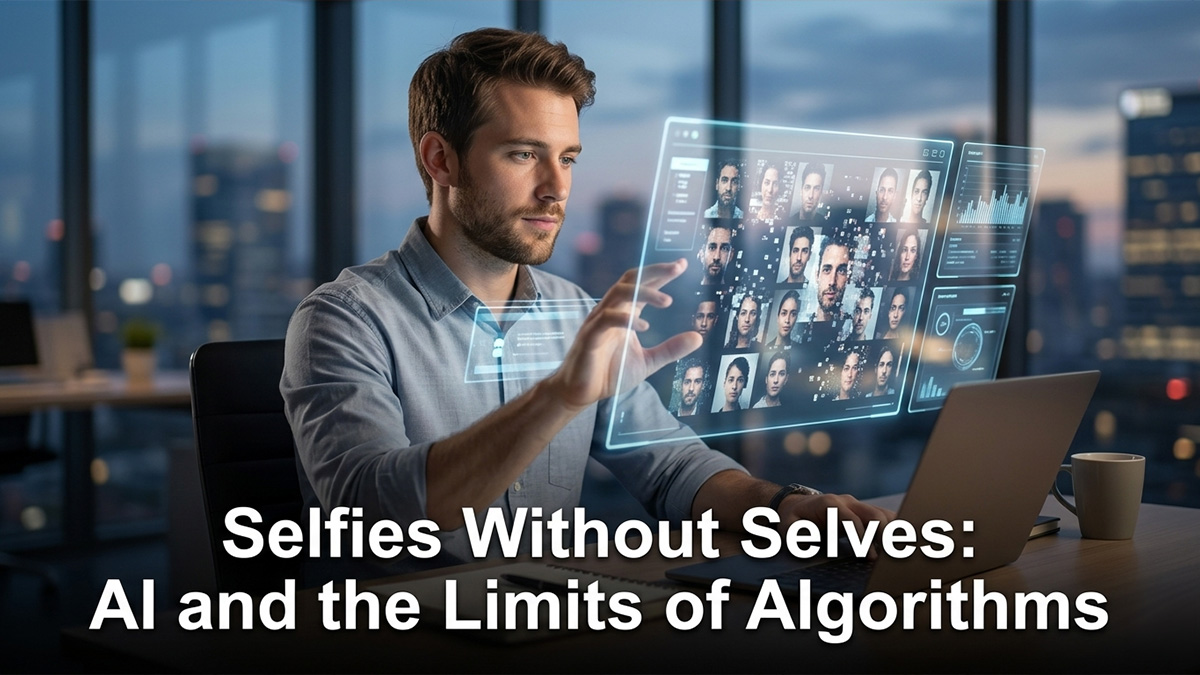
But machines do not understand signals. They merely constitute the coordinates of an algorithmic selfie: a flattened, curated snapshot of our digital behavior, which freezes for the machine’s lens.
When Systems Over-Resolve Context
In my case, certain terms associated with death, combined with patterns the system learned from prior data, likely triggered a classification pathway. The system did not ask: Is this an academic discussion? Does the author intend an analytical analysis? Does the speaker frame it critically rather than suggestively? Engineers did not build it to ask those kinds of questions.
Instead, it asked a simpler question: Does this resemble content that fits a known category?
And once the resemblance was sufficient, the system applied the category.
Incentivizing the Predictable Self
This is not unique to content moderation. Recommendation systems operate similarly. They learn from past behavior and attempt to predict future preference. But preference itself is not static. It evolves with mood, experience, and exposure. The algorithm captures a snapshot and treats it as a pattern.
Content creators have learned to play this game in reverse. They study the signals the algorithm rewards—emotional spikes, familiar tropes, optimized keywords—and shape their work to fit the preferred categories. The payoff is higher engagement, wider reach, and algorithmic love. But creators pay the cost in nuance: what thrives is the version of us that fits the box, not the version that refuses it.
The result is a subtle freezing of the human.
What is dynamic becomes fixed. What is situational becomes generalized. What is exploratory becomes predictable.
Evolving Target
Algorithms are remarkably effective at handling snapshots. Give them enough data, and they can identify patterns, detect anomalies, and make predictions with impressive speed and scale.
But a snapshot is not a life.
Human beings exist across time. We change, often in ways that are not immediately visible in data. We speak in layers—irony, critique, reflection, ambiguity. We move between contexts. We become different versions of ourselves depending on where we are, who we are with, and what we are trying to say.
An algorithm, however, must decide.
It must assign a category, trigger a response, and produce an output. It cannot wait for you to finish becoming who you are at that moment. It cannot hold ambiguity indefinitely. It resolves.
And sometimes, it resolves incorrectly.
In my case, that resolution took the form of a flagged episode and an automated email asking if I was okay. It was almost humorous, but also revealing. The system had mistaken analysis for distress, discourse for danger. It had taken a moving, contextual human act and reduced it to a static category.
Not because it was malfunctioning, but because it was doing exactly what it was designed to do.
This is the limit we are dealing with.
Algorithms can sort what we have been. They can approximate what we might do. But they struggle with what we are becoming.
And perhaps that is the one space that remains human: the ability to change faster than the system can define us.
Read more Stories on Simpol.ph
The Quiet Construction of Artificial Intelligence
Words Without Worlds: Artificial Intelligence and the Limits of Language
Narratives in the New Battlespace: Artificial Intelligence at War