Housing policy often moves quietly—through revised ceilings, updated regulations, and technical adjustments that rarely make headlines. Yet these changes shape everyday realities for Filipino workers, determining not only whether a home is affordable but whether it is safe, durable, and built for long-term living. The government’s recent decision to raise price ceilings for socialized housing projects, while keeping Pag-IBIG Fund’s subsidized loan rates intact, reflects an effort to balance quality and affordability at scale. Updated socialized housing price ceilings Philippines set a new direction for the sector.
Under the Implementing Rules and Regulations (IRR) of the Department of Human Settlements and Urban Development (DHSUD) and the Department of Economy, Planning, and Development (DEPDev) Joint Memorandum Circular No. 2025-001, updated ceilings are now in place to reflect current construction costs. At the same time, Pag-IBIG Fund continues to offer a subsidized 3 percent interest rate under the Expanded Pambansang Pabahay para sa Pilipino (Expanded 4PH) Program—ensuring that improvements in housing standards do not translate into heavier financial strain for workers. It is important to continually monitor the updated socialized housing price ceilings Philippines to assess their impact.
Adjusting Price Ceilings to Improve Quality
The revised price ceilings are designed to respond to rising material, labor, and compliance costs that have constrained developers’ ability to deliver quality socialized housing. By recalibrating allowable prices, the government aims to enable safer construction standards, better finishes, and more resilient designs—without departing from the core mandate of affordability. In fact, updated socialized housing price ceilings Philippines are meant to address both developer challenges and beneficiary needs.
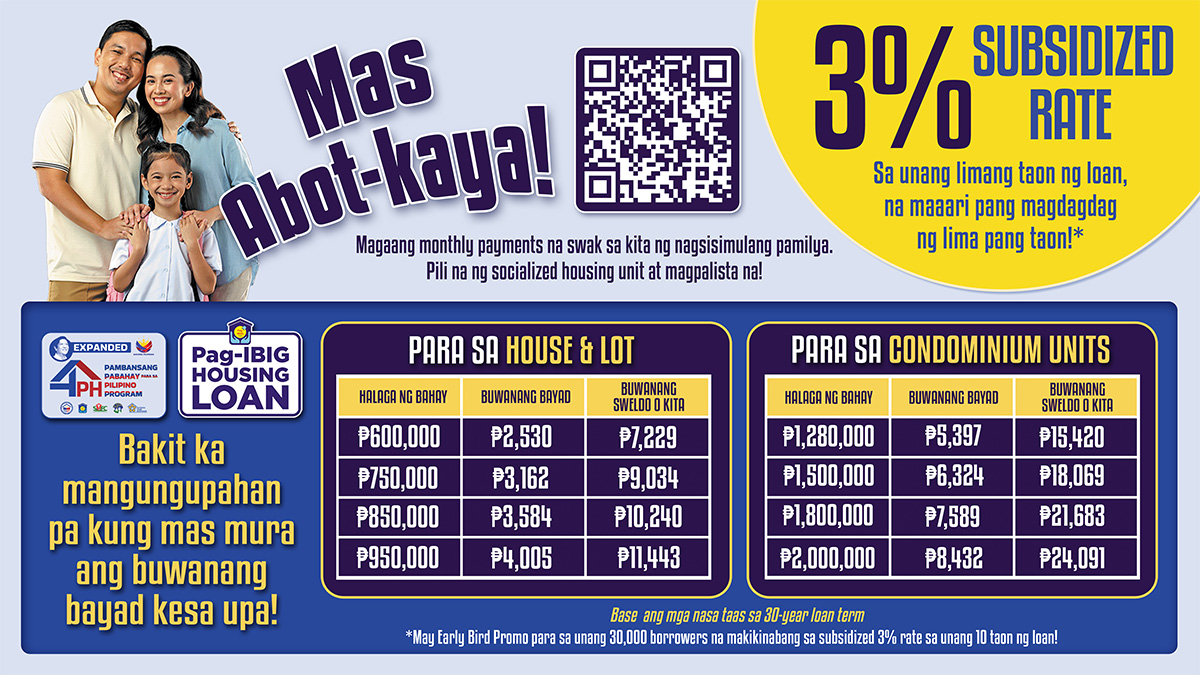
Under the new IRR, the maximum selling price for socialized house-and-lot units is set at ₱844,440 for minimum unit sizes of 24 to 26 square meters and ₱950,000 for units measuring 27 square meters and above. For socialized condominium projects, ceilings vary by building classification and unit size, reaching up to ₱1.8 million for projects above five floors with units of at least 27 square meters.
In the National Capital Region and other highly urbanized cities, the rules also allow maximum add-ons of up to ₱200,000 based on zonal value, bringing the allowable selling price for select condominium units to as much as ₱2.0 million. These adjustments recognize the realities of urban land values while keeping projects within the socialized housing category.
DHSUD Secretary Jose Ramon P. Aliling said the updated ceilings are aligned with the Marcos administration’s housing agenda, which emphasizes both access and quality. “Filipino workers should have access to homes that are safe, decent, and built to last, and that remain within their reach,” he said, noting that the revisions help sustain construction while strengthening the industry’s capacity to deliver homes at scale.
Keeping Affordability at the Center
While higher ceilings allow for better-built units, affordability remains anchored on financing—where Pag-IBIG Fund plays a central role. Despite the updated project prices, the Fund has committed to maintaining its subsidized 3 percent interest rate for qualified borrowers under the Expanded 4PH Housing Loan.
Pag-IBIG Fund Chief Executive Officer Marilene C. Acosta said the agency’s strong fiscal position makes it possible to sustain these rates even as unit quality improves. “Even as better socialized homes become available under the new ceilings, we will keep loan terms affordable and work closely with our partners to help fast-track the availability of more housing units for Filipino workers,” she said. Above all, updated socialized housing price ceilings Philippines are a step toward giving more Filipinos better living conditions.
At the 3 percent rate, monthly amortizations are kept within reach—about ₱4,005 for house-and-lot units priced up to ₱950,000 and approximately ₱8,432 for condominium units priced up to ₱2 million. Through the Early Bird Promo, the first 30,000 qualified borrowers may enjoy the subsidized rate for the first ten years of their loan, extending the benefit beyond the initial five-year period.
Why the Balance Matters
The relevance of this policy shift lies in its attempt to resolve a long-standing tension in socialized housing: the trade-off between affordability and quality. Low price caps can limit what developers can build, while higher prices risk pushing units beyond the reach of intended beneficiaries. By pairing updated ceilings with subsidized financing, the Expanded 4PH framework seeks to address both sides of the equation.
For Filipino workers, the impact is practical rather than abstract. Better-quality units mean safer structures, more livable spaces, and homes that can endure over time. Stable loan rates mean predictable monthly payments and a clearer path to ownership—critical in a context where housing costs are often among the largest household expenses.
By sustaining its 3 percent rate even as project ceilings rise, Pag-IBIG Fund positions itself as a stabilizing force within the housing ecosystem. The approach underscores a broader policy direction: improving housing standards need not come at the expense of access, and affordability, when supported by sound financing, can coexist with quality.
As the Expanded 4PH Program continues to roll out, its success will be measured not only by the number of units built but by whether Filipino workers can move into homes that are both within reach and built to last. In summary, updated socialized housing price ceilings Philippines are meant to support this progression.
Read more Stories on Simpol.ph
What 7,000 New Homes Could Mean for Filipino Families