It is Friday afternoon, and I am doing the arithmetic again.
Payroll is due. A supplier has followed up twice. The rent will not wait. Out front, the dining room is full. Several tables are enjoying a promotion we created to bring more people through the door. By the window, an elderly couple is sharing a meal and laughing over dessert.
The Quiet Weight of Small Business
Being a small entrepreneur in the Philippines can be a painful journey. There are people around you all day, and yet running a business can feel incredibly solitary—a loneliness without quiet.
I have always believed that starting a business is an act of generosity. You put your own money at risk to create something that does not yet exist. You hire people before you are certain customers will come. You take the risk first.

In hospitality, there is even some love in that. But it also means we know exactly whose pocket every peso comes from.
Good Intentions vs. Honest Arithmetic
That is why restaurateurs are watching proposals such as House Bill 7066, which would require statutory senior citizen and PWD discounts to apply on top of promotional offers. Today, a senior or PWD generally receives either the promotional discount or the statutory discount, whichever is more favorable.
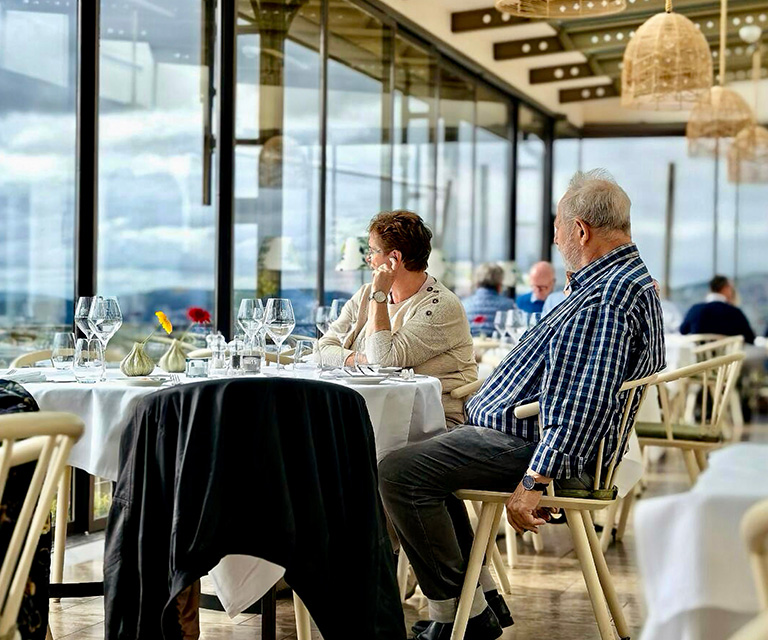
Let me be clear: seniors and persons with disabilities deserve their benefits. Nobody in our industry disputes that. That couple by the window is exactly who we opened our doors for.
I understand the other side. Supporters say a promotion available to everybody should not replace a benefit specifically granted by law. That is a fair point, made in good faith.
But good intentions still need honest arithmetic.
Say that couple’s meal comes to ₱1,000, VAT-inclusive, on a 20% promotion. The price becomes ₱800. Apply the VAT exemption and it is about ₱714. Apply the statutory 20% discount, and they pay about ₱571, roughly 43% below the menu price.
Who absorbs the difference?
The establishment may claim the statutory discount as a tax deduction. But a deduction is not a reimbursement. It reduces taxable income; it does not return the discount peso for peso. How much tax it ultimately saves depends on the business’s taxable income and applicable tax rules.
A promotion is already a decision to give up part of your margin in the hope of gaining volume. Stack another mandatory discount on top of it, and for many small operators, the arithmetic becomes much harder, especially without the scale of a large chain to spread the cost.
Unintended Consequences and a Sustainable Path
Nothing dramatic happens the next morning. The doors still open. The cooks still cook. The changes are quieter. You become more careful about hiring. The new branch waits another year. The promotion that once brought families in on a slow Tuesday no longer makes sense.
We entered business wanting to create more. Little by little, survival can teach you to do less.
There are days when you wonder whether you still own a business or have simply become another worker inside it: working longer hours, carrying the risk, putting in more money just to keep the doors open and everyone paid. When the numbers no longer add up, the responsibility still stops with you.
Behind every dining room are cooks, servers, dishwashers, farmers and drivers. Many have little room to absorb another burden. When something has to give, the cost often travels downward until it reaches someone with nowhere else to pass it.
Every law eventually arrives somewhere very ordinary: a cash register, a payroll, or an owner sitting late at night, going through the numbers again.
If Congress wants discounts to stack on top of promotions, it should also decide how that obligation will be funded.
One approach is tax-credit treatment. Under the original Senior Citizens Act, establishments could claim the senior discount as a tax credit before the system was changed to a deduction. Applying tax-credit treatment to senior and PWD discounts would share more of the cost through the tax system instead of leaving establishments to absorb the discount and claim only a deduction.
Whatever the mechanism, the principle is simple: decide how a public benefit will be funded at the same time it is created. Consult the people who will implement it. Do the arithmetic in the open.
Chef Tatung Sarthou is a cook who talks too much, writes a bit, and occasionally wins awards for both. He’s the man who started Simpol, where he tries to make sense of Filipino cooking—and life—one guisa at a time.
Read more stories on Simpol.ph
Chef Francis Lim: Beyond the Kitchen Chaos