Come May 4, the great ritual of fashion returns: the annual Met Gala, that grand, glittering pageant of ambition and chiffon. This year, Filipino designers Met Gala inspired gowns are drawing new attention as creatives from the Philippines showcase their interpretations of the event’s iconic style. Held, as always, at the prestigious Metropolitan Museum of Art in New York, the evening will once again be presided over by the formidable Anna Wintour, alongside a constellation of co-chairs that includes Venus Williams, Beyoncé, and Nicole Kidman.
The gala marks the opening of the Costume Institute’s newest exhibition, Costume Art, an ambitious survey exploring the dressed body across some five thousand years of human creativity. As with every Met Gala since its modest beginnings as a society dinner, the evening serves a higher purpose: to raise funds for the museum’s Costume Institute. Invitations—those coveted rectangles of social currency—are dispatched only to the most luminous figures of the cultural firmament: celebrities, designers, patrons, and the occasional well-connected socialite whose surname opens doors faster than a skeleton key.
Yet charity, noble though it may be, has never been the sole attraction. The Met Gala is, in truth, fashion’s most theatrical red carpet—a parade of fabric and fantasy unfurling across the museum’s grand staircase. This year’s unspoken diktat, whispered from atelier to dressing room, is elegantly simple: Fashion Is Art.
Which means, of course, that the race has begun.
Stylists and designers are already deep in their conspiratorial fittings, sketching, draping, and occasionally panicking. No guest hopes to be immortalized by the paparazzi in anything less than magnificent. The reward for success is immortality in the morning’s style pages; the punishment for failure is equally eternal, though rather less flattering.
From my vantage point—one seasoned, perhaps a touch sentimental—it is impossible not to wonder whether a Filipino designer might one day claim those famous steps. The Philippines, after all, possesses a treasury of textile traditions as rich as any European archive. Why shouldn’t they have their moment beneath the chandeliers?
So, in a spirit of both mischief and patriotism, I posed a challenge to several notable Filipino designers: imagine a gown worthy of the Met Gala, but fuse it with indigenous materials—let the Filipino hand and heritage speak boldly through couture.
Many received the invitation. A brave few accepted.
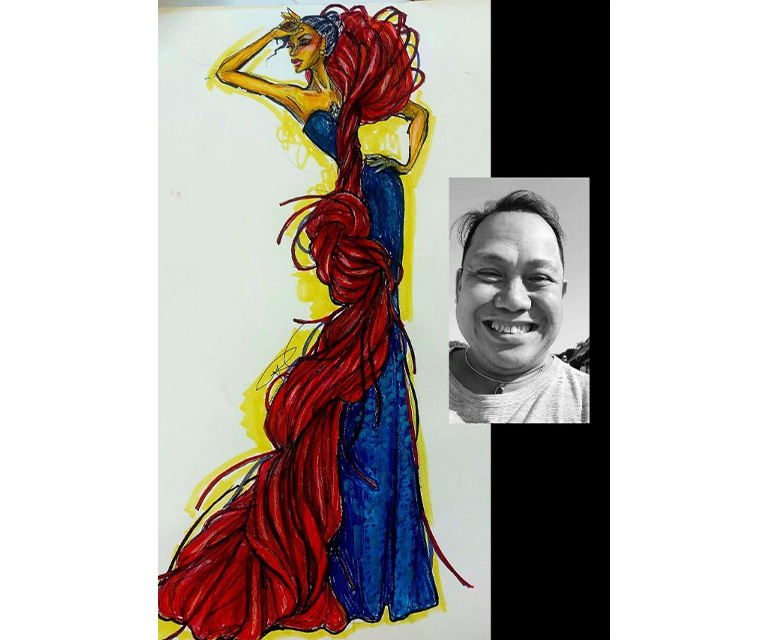
Ramil Noveda
The international award winning designer Ramil Noveda, now based in the Emirates, answered with a study in dramatic movement.
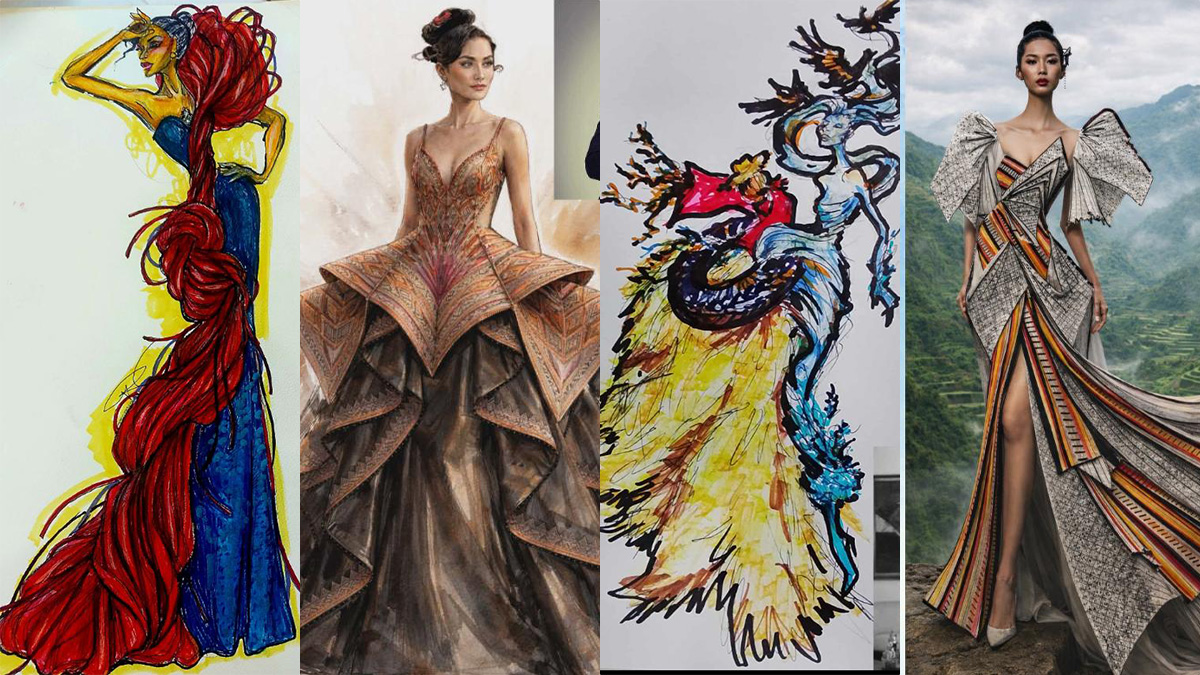
His vision: cascading drapery fashioned from red-dyed piña and copper-toned fabric, delicately lined with organdy. Strips of crimson rattan weave through a one-sided hablon textile, while sprays of dyed mother-of-pearl and crystals glimmer like embers caught in silk.
The result feels both elemental and ceremonial—something that might sway beautifully beneath the flashbulbs of Fifth Avenue.
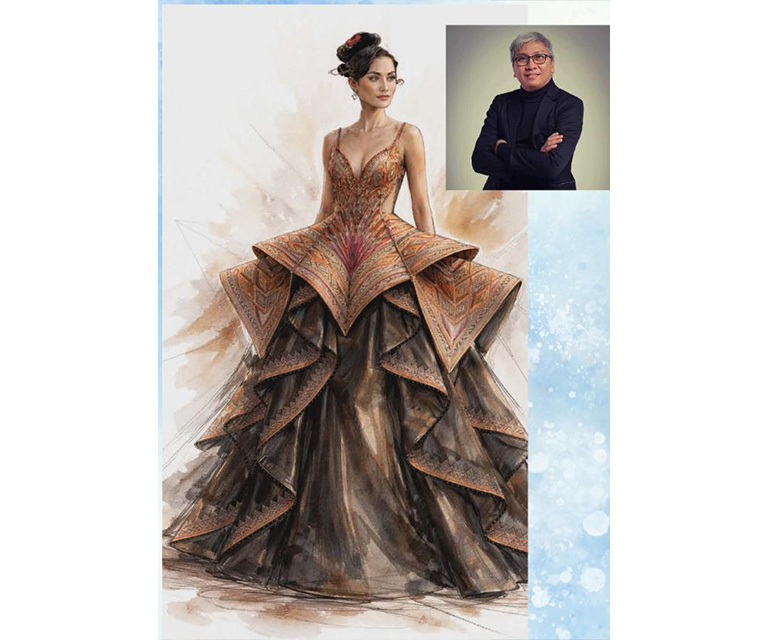
Russ Cuevas
For Russ Cuevas, grand prize winner at last year’s Precious of Malaysia Cultural Festival, the inspiration lies deep in Mindanao’s cultural memory.
His avant-garde gown centers on T’nalak, the sacred textile woven by the T’boli people from abaca fibers. According to tradition, the intricate patterns arrive to the weaver in dreams—motifs believed to carry spiritual protection.
Cuevas transforms this ancestral cloth into a commanding couture silhouette. A corseted bodice, structured in T’nalak fiber, radiates geometric motifs from the center like protective emblems. From the waist extend dramatic architectural panels, echoing the symmetry of tribal design while creating a modern, almost armor-like elegance.
Below, a voluminous skirt spills downward in dark cascading layers, unfolding like petals. The indigenous textile dominates the upper structure, reminding the viewer that couture need not erase heritage—it can exalt it.
The gown reads less like a costume than a conversation across centuries.
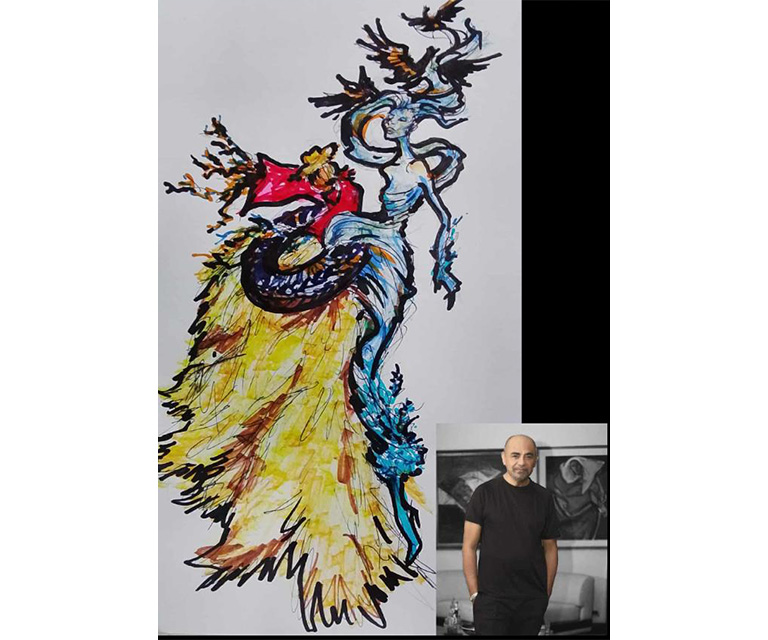
Jan Garcia
The provocateur of the group is Jan Garcia, known for theatrical creations that flirt gleefully with the absurd.
His piece bears the mischievous title “Panakot-Uwak sa Ibabaw ng Dayaming May Goma”—loosely translated as Scarecrow on a Haystack with Rubber Tire Weight. One suspects the Met steps have never seen anything quite like it.
Strips of piña and ba’ag—a bark cloth from Palawan—explode outward from a front panier structure, while the bodice whirls upward in a fully beaded organza-and-tulle formation he calls an ipu-ipo, or whirlwind.
It is rural surrealism rendered in couture, equal parts satire and spectacle.
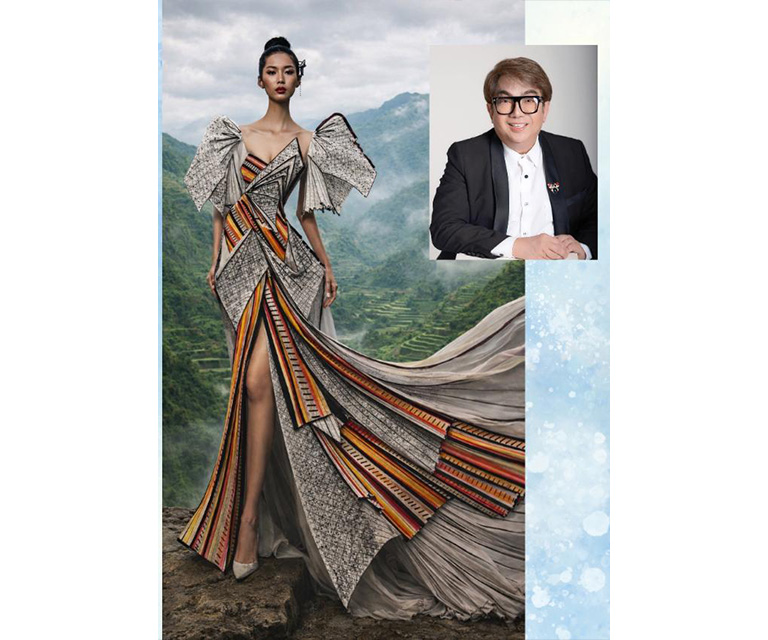
Albert Andrada
Finally, there is Albert Andrada, the celebrated designer whose gowns have graced international pageants and royal wardrobes.
Andrada’s proposal is perhaps the most architectural of the quartet. Drawing inspiration from the Cordillera, he combines the bold geometry of Cordilleran textiles with the delicate intricacy of calado fabric.
The silhouette rises with sculptural precision, while a pleated train cascades behind the wearer like wind sweeping across the emerald rice terraces of the highlands.
The effect is both modern and reverent—a tribute to ancestral craft translated into the vocabulary of haute couture.
The Dream of the Met Steps
The Met Gala will, of course, continue its glittering procession for years to come. The staircase will remain the same; the cameras will flash with their usual hunger.
But somewhere, perhaps sooner than we think, a Filipino designer’s creation may ascend those storied steps—its indigenous fibers catching the light of Manhattan like a quiet declaration.
And when that moment arrives, dear reader, I shall be watching.
Until the next season of spectacle—
Bisou, bisou.
Read more Stories on Simpol.ph
Threads Through Time: How Fashion Evolves Across Generations