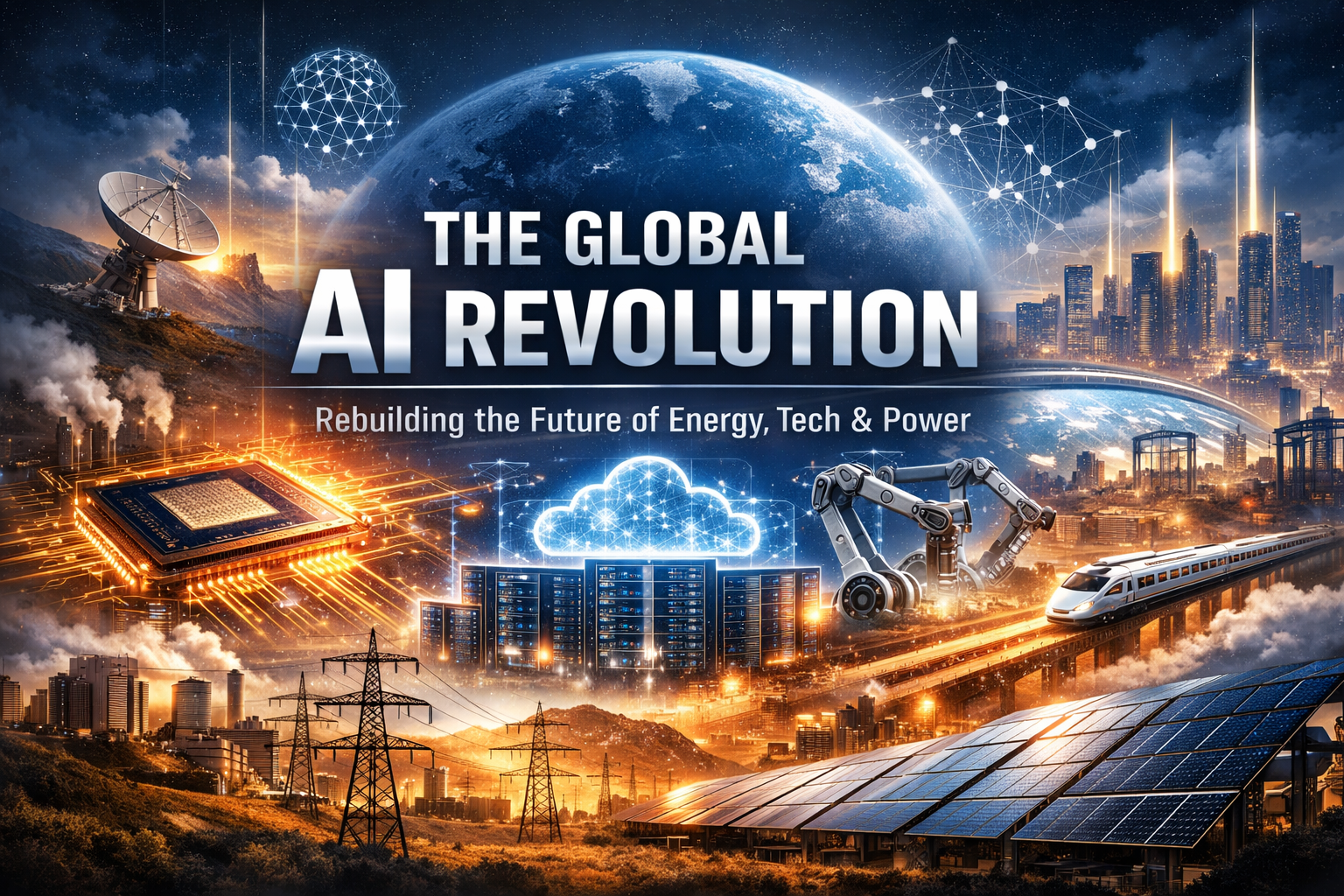
Artificial intelligence is often framed as a feature upgrade—faster tools, smarter applications, more seamless automation. That framing obscures the scale of what is underway. Discussion around AI infrastructure and national intelligence Philippines is now at the forefront as these initiatives are becoming increasingly important in the country while technology continues to advance. At the 2026 meeting of the World Economic Forum in Davos, Jensen Huang, president and chief executive of NVIDIA, described AI not as incremental improvement but as a platform shift on the order of the personal computer, the internet, and mobile cloud computing. Each of those transitions did more than raise productivity. They reordered labor markets, reshaped capital flows, and redistributed power.
What distinguishes this moment, he argued, is simultaneity. Energy systems, semiconductor manufacturing, cloud infrastructure, AI models, and applications are scaling at once. AI is not diffusing gradually; it is industrializing. Capital is pouring not only into software but into fabrication plants, data centers, power generation, and logistics networks. By scale and scope, Huang called it “the largest infrastructure buildout in human history.”
The implication is as bracing as it is clear: the world is not preparing for AI. It is reorganizing around it. Countries that delay are not standing still; they are ceding ground in real time.
The Five-Layer Stack
To grasp the speed of AI’s advance, it helps to see it not as a single technology but as an integrated stack. Huang likened it to a five-layer cake. At the base is energy. Systems that reason in real time consume vast amounts of power. Above that are chips—processors and memory architectures optimized for parallel computation. Next comes cloud infrastructure, increasingly described as “AI factories,” where intelligence is produced at scale. Only then do we arrive at AI models. At the top sits the application layer, where economic value is realized.
In earlier technological eras, these layers evolved sequentially. Hardware matured before software; networks expanded before platforms. Today, each layer accelerates the others. More capable models drive demand for additional compute. Expanded compute enables richer applications. Those applications justify still larger infrastructure investments. The result is a feedback loop that compresses timelines and entrenches advantage.
If the moment feels overwhelming, it is not because hype has outrun reality. It is because infrastructure has begun to outrun governance. And once infrastructure is laid, it tends to define the competitive landscape for decades.
National Infrastructure, National Intelligence
Much of the public anxiety surrounding AI centers on employment: Will machines replace workers? In practice, AI more often automates tasks than purposes. When discrete tasks are automated, human roles frequently expand into judgment, care, coordination, and oversight. Productivity rises; demand adjusts; new forms of work emerge.
For developing countries, the more urgent question is not displacement but capacity. AI should not be treated as a luxury technology or consumer convenience. It belongs alongside electricity, transport, and telecommunications as foundational infrastructure. No nation debates whether it should have roads; the debate concerns quality and access. Huang’s argument in Davos was that AI deserves similar treatment.
Understood this way, “national AI” is not a slogan of technological nationalism. It is a question of competence. It is the ability to deploy systems that understand local languages, histories, and institutional realities. Language and culture are not peripheral variables; they are strategic assets. Models trained exclusively on external data encode external priorities. Models shaped by local data can support education, public health, disaster response, governance, and entrepreneurship in ways that reflect domestic needs.
National intelligence, in this sense, is the capacity of a society to encode and apply its own knowledge within emerging systems.
The Philippine Constraint
That capacity cannot be built on imported tools alone. It requires domestic research ecosystems—institutions and individuals who generate knowledge rather than merely consume it. On this measure, the Philippines faces structural constraints.
Data compiled by UNESCO indicate that the Philippines has roughly 170 researchers per million people, well below the global average of about 380 per million associated with sustained scientific and technological development. International science-policy analyses have long suggested that countries approaching innovation takeoff typically require at least double that density to sustain independent knowledge production and adaptation.
The challenge is less a deficit of talent than of structure. Many higher education institutions are designed primarily for instruction. Faculty members carry heavy teaching loads; research funding is limited and fragmented; protected research time is scarce. National science road maps have repeatedly warned that without a stronger research base, the country will struggle to convert emerging technologies into locally grounded solutions.
AI does not eliminate the need for research; it magnifies it. Countries with deep research capacity can translate AI advances into pharmaceuticals, advanced materials, agricultural systems, and public services. Those without such capacity risk becoming end users of systems designed elsewhere.
Consider a future classroom in which students converse with a digital rendering of José Rizal. The technology to build such an interface is foreseeable. The more consequential question is whose Rizal would speak. Without sustained investment in scholars, curated data sets, and local model development, that voice could reflect assumptions formed outside Philippine historical debate and linguistic nuance.
Long-standing structural issues—brain drain, weak industry–academe linkages, low research and development spending, uneven digital infrastructure, and some of the highest electricity costs in Southeast Asia—compound the risk. In an AI-driven economy, a thin research base is not a temporary setback but a structural disadvantage that can persist for decades.
Speed and Governance
Global institutions have begun to respond. The United Nations has initiated scientific advisory mechanisms to examine AI and inform governance, reflecting a growing recognition that technological velocity is outpacing institutional adaptation.
For the Philippines, the lesson is not that AI is inevitable, though it may be. It is that delay carries cost. Infrastructure eras favor early builders—those willing to invest not only in machines but in people.
As Huang cautioned in Davos, the transformation is not slow moving.
The central risk is not that AI will alter too much of modern life. It is that it will evolve faster than our capacity to shape it. National intelligence is not a rhetorical flourish for some distant horizon. It is a present requirement.
Read more Stories on Simpol.ph
Quiet Service, Lasting Impact: The Story of Ruth D. Cruz
D’Luxe Medical and Aesthetics by Dr. Lance: Elevating Beauty and Wellness Care in Balanga, Bataan
Arabelle Dela Cruz Makes History as Grand Champion of Veiled Cup Korea