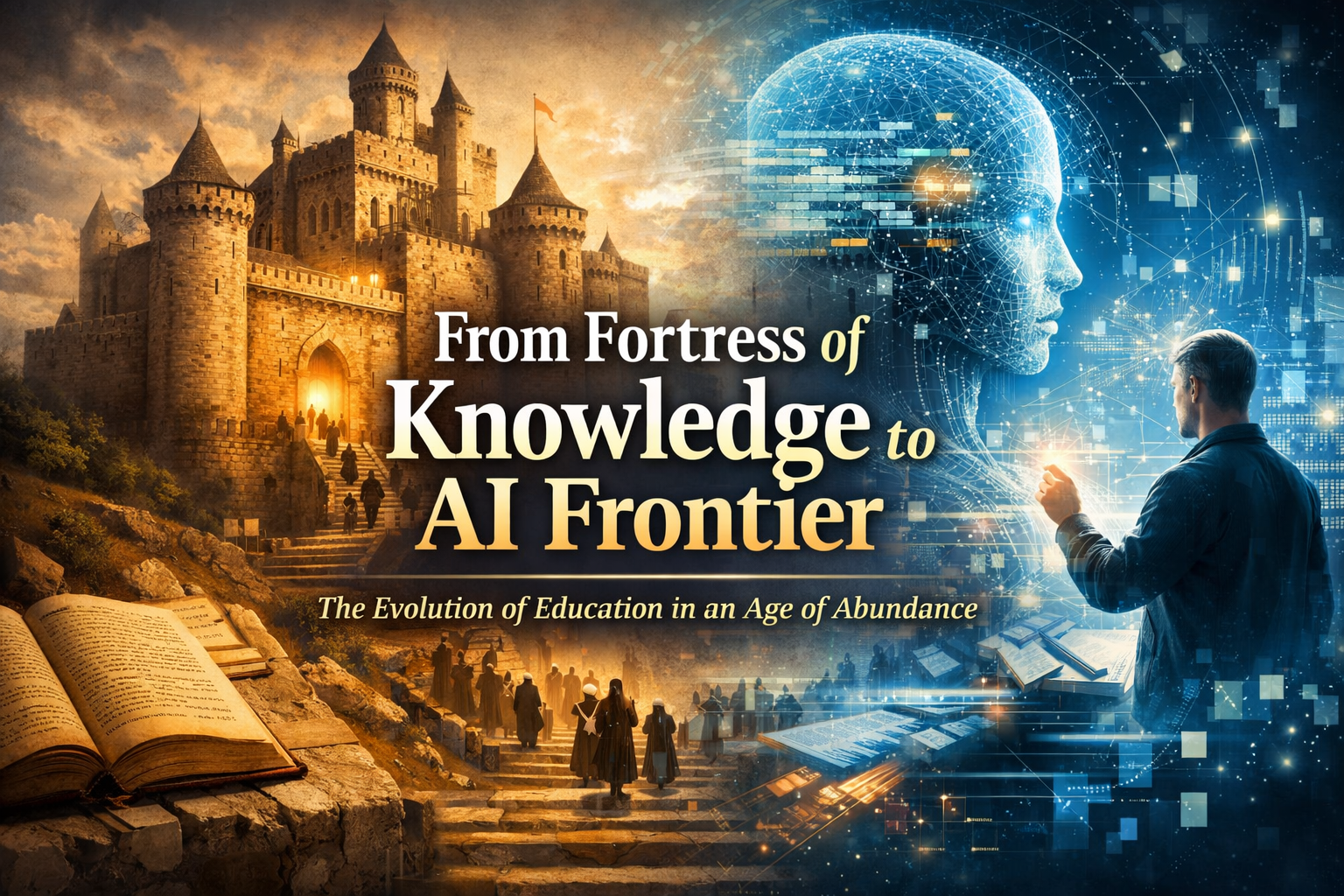
For nearly a millennium, the university has functioned as a fortress built to protect a single, precious resource: scarce knowledge. Clearly, AI and the Future of Higher Education is reshaping what counts as scarce knowledge today.
In a world of rare manuscripts and isolated experts, physical proximity was the only ticket to enlightenment. The university emerged as one of humanity’s most durable solutions to this scarcity—concentrating scholars, texts, and intellectual traditions in one place to transmit wisdom across generations. Today, however, the fortress walls are not being stormed; they are simply becoming irrelevant as the resource they were built to guard becomes as abundant—and as messy—as the air we breathe. In reflection, one might wonder how the future of higher education and AI together will redefine ideas of scarcity and abundance.
Artificial intelligence is the quiet force dissolving the bedrock of that thousand-year-old assumption. As we navigate this shift, however, we are also forced to confront a localized crisis that demonstrates just how dangerous our obsession with “knowledge as commodity” has become. Ultimately, this situation will be transformed by AI and the Future of Higher Education.
The Perils of Proxy
In the Philippines, the Second Congressional Commission on Education (EDCOM 2) recently exposed a troubling reality: the proliferation of “colorum” diploma mills offering graduate degrees with little academic rigor. Reports have even described cases in which students pay for prewritten dissertations or offer gifts—such as Lacoste shirts—to panel members in exchange for passing marks. The result is a “paper chase” increasingly divorced from genuine learning. At this juncture, the interplay between higher education, AI and their combined future must be considered to tackle these growing concerns.
This is the scarcity model gone rogue. Historically, universities bundled three things: access to knowledge, access to networks, and the issuance of credentials. In the Philippines, the system has become so fixated on the credential—the proxy for knowledge—that it has allowed actual learning to evaporate. As EDCOM 2 executive director Dr. Karol Mark Yee has observed, when degrees become mere transactions for promotion, the system is no longer educating a workforce; it is institutionalizing “miseducation.”
Replacing this broken institutional model with a frictionless AI-driven alternative, however, carries its own anthropological risks. Overreliance on AI could erode critical thinking, as users default to machine-generated explanations without wrestling with concepts themselves. Moreover, AI systems inherit biases from their training data, potentially perpetuating distortions in the distribution of knowledge—such as privileging Western perspectives in global datasets. Significantly, AI and the Future of Higher Education must be addressed as universities consider new models.
From an anthropological perspective, this may fragment the shared cultural narratives that once unified learning communities, creating echo chambers in which “understanding” is personalized but insufficiently examined. Therefore, understanding AI’s influence on the future of higher education remains crucial.
The Human Arena
This “unbundling” of the university unfolds differently across cultural contexts. In the Global South—where institutional access remains uneven because of infrastructure gaps—mobile AI tools could leapfrog traditional barriers, enabling rural learners in places such as the Philippines to access world-class explanations through smartphones. Thus, the roles of AI and the evolving landscape in the future of higher education are brought into sharper focus.
Yet such possibilities also carry risks of cultural erosion. Indigenous knowledge systems, rooted in oral traditions and the authority of community elders, may clash with algorithm-driven outputs that prioritize data from dominant cultures. Anthropologically, the global expansion of AI could either bridge longstanding divides or impose a new form of epistemic colonialism. At the same time, culturally attuned AI verification systems might help counter local academic fraud, including diploma mills, if deployed thoughtfully. Overall, these developments compel us to examine the impact of AI and the Future of Higher Education on local communities.
As AI dissolves the university’s monopoly on information, the institutional bundle is beginning to separate. What remains uniquely human are the dimensions an algorithm cannot truly simulate: mentorship, intellectual community, and identity formation. Therefore, discussions around AI and the Future of Higher Education highlight the importance of preserving these human elements.
The lecture itself emerged historically as a practical solution to scarcity. One expert speaking to hundreds of students was never ideal pedagogy; it was a bandwidth solution. In a world where expert knowledge was limited, broadcasting information to many listeners at once made institutional sense. Seen in this light, lectures functioned like an early communication technology: one speaker, many listeners, limited feedback, and standardized pacing. This historical context frames current conversations on AI reshaping higher education’s future.
AI succeeds because it removes friction. Yet deep learning—the kind that alters a person’s character—requires friction. It requires the discomfort of being proven wrong by a peer and the social accountability of a physical community. The university’s future lies not in its efficiency but in its ability to create the “productive struggle” that a frictionless algorithm—or a transactional diploma mill—cannot replicate. In this light, the debate around AI and the Future of Higher Education takes on new urgency.
If this transformation occurs, the university will resemble less a library and more an arena. In an arena, ideas are tested rather than merely stored. Intellectual character is formed through argument, failure, and collaborative discovery. These processes cannot be downloaded, automated, or entirely outsourced to machines.
Rediscovering the Purpose of Education
The arrival of AI does not eliminate the need for education; rather, it intensifies it. At the same time, it demands a move away from the proxy of the degree itself. As portfolios, real-time demonstrations, and AI-accelerated tools—such as blockchain-verified simulations—allow individuals to show what they can actually do, the authority of the “bought” diploma will inevitably weaken. In short, a renewed sense of purpose for higher education emerges side-by-side with AI’s advancement.
For centuries, universities were organized around the scarcity of knowledge. AI marks the moment when knowledge became abundant—and when the real purpose of education had to be rediscovered. Clearly, these shifts are central to debates about AI and the Future of Higher Education.
AI can provide answers with staggering speed, but answers are merely the debris of the learning process. The true goal of education has always been the development of judgment: the ability to ask meaningful questions, recognize cultural bias, and navigate the consequences of ideas. In light of these goals, higher education’s future must be transformed by AI’s capabilities.
The end of the knowledge monopoly, therefore, is not the end of the university. Instead, it may mark the beginning of its truest purpose: teaching not merely what to know, but how to think, question, and exist responsibly in a world of abundant yet contested truth. Thus, the ongoing journey of AI and the Future of Higher Education is far from over.
Read more Stories on Simpol.ph
Ready or Not, the Intelligence Age Is Here
What happens when machines start teaching our children how to feel?
Ghostwritten by the Machine: AI and the Evolution of Storytelling