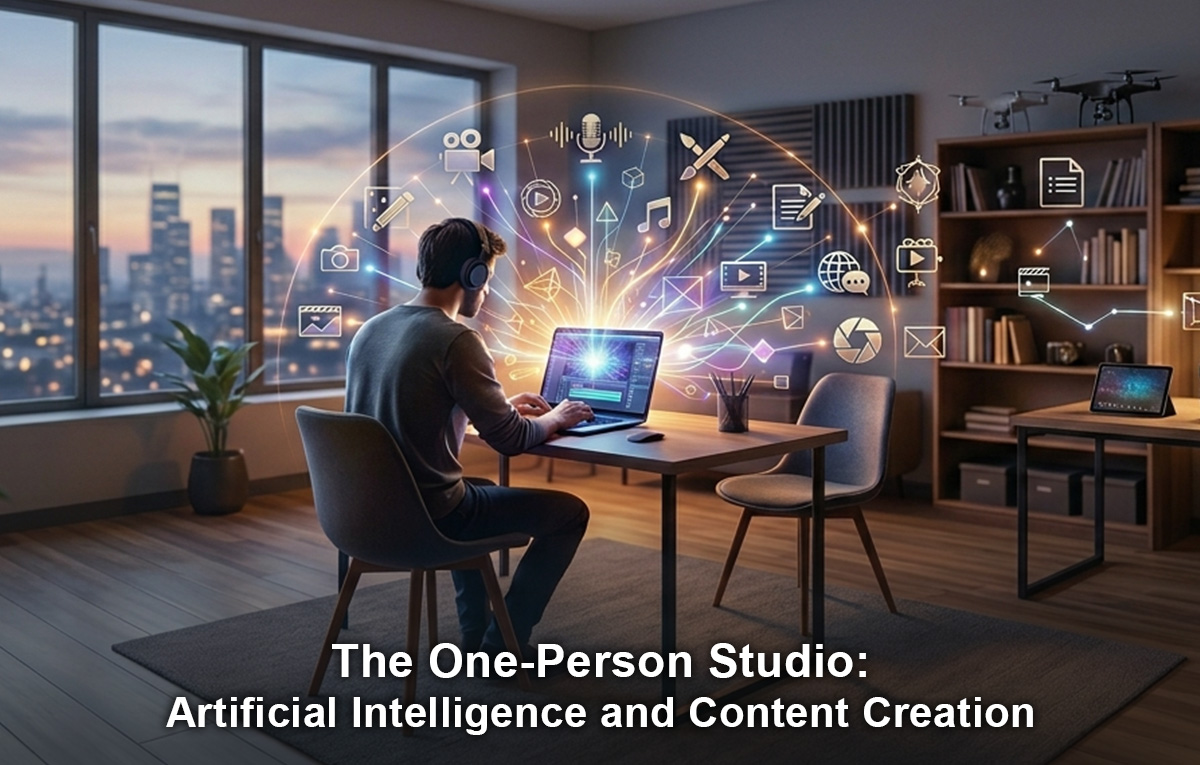
Imagine a person sitting before a laptop with an idea. It could be an essay, a podcast, a short film, a lecture, a campaign, or a song. Within the same workspace, that person can now develop the concept, draft the script, generate images, produce narration, create music, edit video, translate the finished material, and prepare versions for several platforms.
Not long ago, these activities required a creative department or production team. There might have been a writer, researcher, illustrator, photographer, composer, voice performer, editor, translator, and social media manager. Increasingly, one creator can coordinate many of these functions alone.
Artificial intelligence is therefore doing more than accelerating individual tasks. It is changing the scale of what an individual can produce and the number of creative roles that person can occupy.
The creator is becoming a one-person studio: one human mind directing an expanding collection of artificial capabilities.
The One Who Directs
This transformation is already visible in the tools entering ordinary creative workflows.
A creator can use large language models to brainstorm, organize research, test possible structures, and produce an early draft. Advanced video and image generators can instantly produce visual concepts and video sequences, while specialized audio platforms handle narration, original music tracks, and multilingual dubbing.
Even editing has shifted: video and audio can now be edited directly through text transcripts, making the process resemble the revision of a simple document. Collaborative design platforms can then assemble these components and adapt them into presentations, posters, and social media formats.
The significance lies less in any single application than in the way these tools connect previously separate forms of production. One idea can become an article, a podcast, a narrated video, an infographic, a translated version, and a collection of promotional clips. The creator no longer needs to master every technical process or personally execute every step.
This changes the nature of creative work. The creator increasingly resembles a director leading a production crew, except that much of the crew is artificial. The human defines the concept, issues instructions, evaluates the results, rejects weak outputs, corrects errors, and combines separate elements into a coherent whole.
Experiments with multi-agent systems are also beginning to appear in marketing and production workflows. Future systems may handle chains of related tasks: researching a subject, proposing several treatments, generating supporting assets, reformatting material for different platforms, scheduling publication, and analyzing audience response.
Creative work does not disappear in this arrangement. It moves away from some forms of execution and toward direction, selection, judgment, and taste. The important skill may no longer be simply knowing how to make something. It may be knowing what to request, what to keep, what to change, and what should never be published.
The One Who Does It All
The one-person studio carries a powerful democratic promise.
A creator no longer needs to live near a major media center, gain admission to a prestigious institution, or secure a large production budget before an idea can take visible form. A teacher can produce educational media.
A small business can develop its own campaign. An independent artist can create work that previously required expensive equipment and specialist assistance. Local stories can be translated and circulated far beyond their place of origin.
Ideas once blocked by cost, geography, technical skill, or institutional access may finally become possible.
But creative independence has another side. The same systems that empower individual creators may encourage employers and clients to expect one person to perform work previously distributed among several specialists. A writer may also be expected to research, design graphics, record narration, edit video, create captions, translate material, and promote it across platforms. What appears to be liberation may also become intensified labor.
The one-person studio could therefore mean fewer crews—not because every specialist has become unnecessary, but because institutions may decide that fewer people are sufficient. Editors, illustrators, translators, voice performers, composers, and production workers may be brought in only after artificial systems have produced an inexpensive first version, or reserved for projects with larger budgets.
Access must also be distinguished from equality. Many creators may use similar tools, but they will not possess equal time, training, computing power, visibility, or platform influence. More people may produce content without gaining a fair share of attention or income.
There is also the risk of cultural sameness. When creators rely on the same models, templates, synthetic voices, and aesthetic conventions, polished work may begin to look and sound alike. Preserving cultural and stylistic distinctiveness will require deliberate effort. Raw AI output must remain material to be reshaped by human voice, cultural perspective, and editorial judgment.
AI may democratize production without democratizing employment, income, attention, or cultural power.
The One Who Must Still Answer
The lone creator at the laptop may soon command capabilities once distributed across an entire organization. But the tools cannot independently decide what matters, whose story deserves to be told, what should remain private, what is culturally appropriate, or what is true.
They can generate endless possibilities, but they cannot take responsibility for a single one. As technical work becomes easier, the human role becomes more critical. Someone must still provide direction, coherence, ethical boundaries, and purpose. Someone must answer for the choices embedded in the finished work.
And the one-person studio is never truly one person working alone. Its artificial crew has been built from the accumulated language, images, performances, knowledge, and labor of countless human beings.
The future creator may command an entire studio from a single screen. But greater creative power does not reduce human responsibility. It enlarges it. The question is no longer only what one person can make, but what that person chooses to make—and why.
Read more Stories on Simpol.ph
Ghostwritten by the Machine: AI and the Evolution of Storytelling
What happens when machines start teaching our children how to feel?