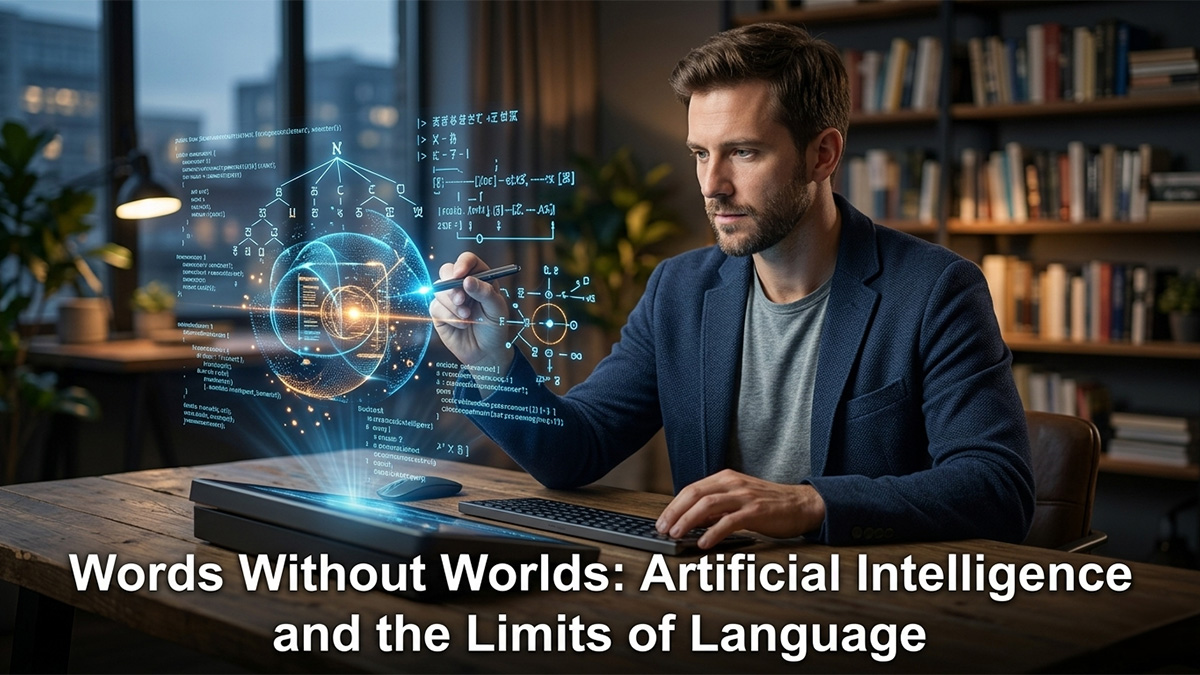
It starts quietly. You’re working late—maybe preparing a lecture, drafting an article, or trying to make sense of a difficult idea. You type a question into an AI system, half-expecting a rough answer. Instead, what you get is something startlingly composed. The sentences flow. The argument builds. It even anticipates your next question. For a moment, you pause—not because the answer is correct, but because it feels like it understands you.
That feeling is the story of our time.
We are living in a moment where language feels like intelligence. Ask a question, and an answer appears—fluid, confident, often persuasive. For many, that is enough. The machine speaks well, therefore it must understand. But this is precisely the illusion that defines our relationship with large language models (LLMs) today. They do not think in the way we imagine thinking. They do not know in the way we imagine knowing. What they do—remarkably well—is generate language that resembles understanding.
Language Without Experience
At the core of systems like these is a simple but powerful mechanism: the prediction of the next word. Trained on vast amounts of human text, they learn patterns—how words tend to follow one another, how arguments are structured, how tone shifts depending on context. This gives them an extraordinary fluency, a capacity to produce responses that feel coherent and even insightful. But as Yann LeCun has repeatedly pointed out, fluency is not the same as intelligence. These systems lack what he calls a “world model”—an internal, causal representation of how reality actually works, built through interaction rather than text prediction.
Think about how humans learn. A child does not begin with language alone. They learn by touching, falling, testing, observing consequences. Knowledge is grounded in experience—it is causal. When we say we understand something, we mean that we can relate it to the world, anticipate outcomes, and adjust when we are wrong. Large language models do none of this. They operate entirely within the statistical structure of text. They are, in a very real sense, closed systems—trained on descriptions of the world, but never in contact with the world itself.
Patterns Without Purpose
This is where the distinction between correlation and causation becomes critical. Language models are masters of correlation. They can identify that certain words, ideas, or arguments tend to appear together. But they do not understand why those relationships exist. As a result, they can produce answers that are syntactically perfect yet fundamentally ungrounded.
An LLM knows the linguistic proximity of the words “gravity” and “drop,” but it has no concept of weight or the visceral finality of a glass shattering on a tile floor. It can replicate the syntax of a crash without ever grasping the impact. When they “hallucinate,” they are not malfunctioning in the way a broken machine does. They are doing exactly what they were designed to do: extend patterns in plausible ways, even when those patterns no longer correspond to reality. They optimize for coherence, not truth.
This becomes especially visible when novelty enters the picture. Situations that fall outside familiar patterns—complex, ambiguous, or cross-domain problems—can expose the limits of these systems. Consider a policymaker in the Philippines grappling with urban flooding in Metro Manila: an LLM might synthesize reports on climate data, infrastructure, and economics, but without grounded causal understanding of local topography, governance realities, or lived community impacts, its recommendations risk being elegantly hollow. They may generate explanations that sound convincing but collapse under scrutiny. Not because they are close to understanding and just need refinement, but because their architecture does not support causal reasoning in the first place.
Symbols Without Substance
Philosophers have long wrestled with the idea that a system can manipulate symbols without understanding their meaning. In 1980, John Searle proposed the “Chinese Room” thought experiment: imagine a person in a room who speaks no Chinese but follows a complex rulebook to process Chinese characters. To an observer outside, the person’s responses are indistinguishable from a native speaker’s. Yet, the person inside understands nothing; they are simply matching patterns.
Today, that abstraction has become an everyday reality, running on our machines. We are confronted with machines that can simulate understanding so convincingly that we begin to attribute understanding to them. But simulation is not equivalent. Producing language about the world is not the same as engaging with it.
From an anthropological perspective, this distinction matters deeply. Language is a cultural artifact. It encodes how humans describe, interpret, and make sense of their experiences. When a language model is trained on human text, it becomes a mirror of that cultural layer. It reflects our metaphors, our biases, our assumptions, our ways of explaining things. But it does not step outside of that layer. It cannot verify, challenge, or ground those patterns in lived reality.
In this sense, these systems are not epistemic agents. They are cultural mirrors. They reproduce discourse; they do not inhabit the world that discourse describes.
The Map is Not the Terrain
So we return to that quiet moment—the late-night question, the elegant answer, the brief sense that something on the other side understood. The words were right. The structure was right. The feeling was real.
But the understanding was ours.
Large language models are powerful tools. They can help us organize thought, explore ideas, and navigate the vast terrain of human language. But they do not replace the processes by which knowledge is built—through observation, experimentation, and experience.
Language is the map. Large language models are extraordinary cartographers of that map.
But they never touch the terrain.
Read more Stories on Simpol.ph
The Intelligence Explosion Has Come!
Has ChatGPT Become Your Friend, Confidant—and Therapist?
What happens when machines start teaching our children how to feel?