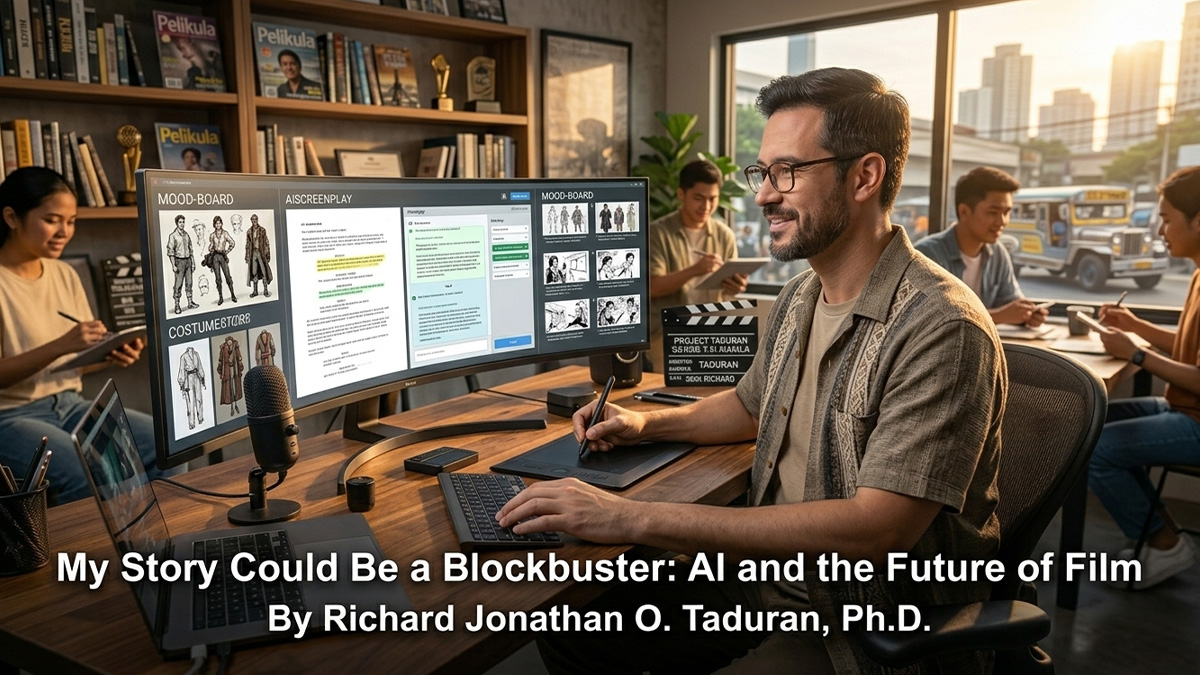
Imagine opening a future streaming platform and, instead of scrolling through endless titles, simply telling it what you want.
A romantic comedy starring Robert Downey Jr. and Audrey Hepburn, set in London, where two Americans accidentally meet.
You choose the season—winter, summer, spring, or fall. You ask for a Nora Ephron-style treatment: warm dialogue, emotional wit, chance encounters, and longing hidden beneath ordinary conversation. Then you make it like Love Actually, but in anthology form, a miniseries of interconnected stories. While searching for a partner for David Duchovny, the algorithm suggests Gillian Anderson.
After several rounds of prompting and revising, the system begins to assemble your request.
The fantasy is seductive. Your taste becomes a studio. Your imagination becomes a production house. Your private daydream becomes a blockbuster.
But when everyone can generate a film, what happens to cinema?
From Streaming to Storymaking
For more than a century, film has been built around scarcity. Cameras were expensive. Studios controlled distribution. Actors, directors, editors, composers, cinematographers, and designers worked together to transform an idea into something visible. Even in the age of streaming, the audience still entered the process at the end. We watched what others had already made.
Generative AI changes that sequence. The viewer no longer waits at the end of the pipeline. The viewer can now enter at the beginning.
AI video systems such as Seedance, Kling, and multimodal systems like Gemini Omni show how quickly this shift is unfolding. These tools are moving beyond novelty clips toward multi-shot scenes, cinematic control, multimodal input, synchronized sound, and conversational editing.
The point is not that they can already replace a finished studio film. They cannot. The point is that they are beginning to rearrange the relationship between imagination and output.
This is not merely text-to-video. It is the early architecture of storymaking on demand. A person may soon ask not only for a scene, but for a mood, a genre, a recurring character, a visual style, a soundtrack, a plot reversal, and a revised ending. The interface of cinema becomes language. To speak clearly is to direct.
This may democratize filmmaking in extraordinary ways. A student with no camera could stage a historical drama. A poet could turn grief into a short film. Independent creators may experiment without waiting for permission, funding, or institutional approval. But once everyone can make a film, the difficult question is no longer whether a story can be produced. The difficult question is whether it should be—and what kind of shared culture we are willing to trade away in exchange for that ease.
The Private Screen
Cinema has always been personal, but it has also been communal. Long before cinema, humans gathered around fires to tell stories. Those stories carried warnings, memories, desires, and explanations for the world. Cinema became one of the modern descendants of that ancient ritual: a shared darkness, a gathered audience, a story larger than the self. In the age of AI, those fireside stories may become films.
That is thrilling, but it may also weaken common culture. We remember films together. We quote lines together. We argue about endings, performances, villains, kisses, costumes, and songs. A film becomes part of culture because many people encounter the same object and then build meanings around it. Even disagreement requires a shared reference.
Personalized AI cinema may disrupt that.
If my film is generated only for me, adjusted to my preferences, shaped around my nostalgia, and populated by faces I already love, then it may move me deeply.
But who else has seen it?
Private, however, does not have to mean hidden—nor does it mean unprofitable.
In fact, this potential fragmentation of the audience is already being reimagined as a lucrative new ecosystem. Market forces are stepping in to institutionalize our private daydreams. Disney’s agreement with OpenAI already sketches the corporate outline of this future. Even though OpenAI has discontinued the Sora web and app experiences, the deal remains significant: it covered not only fan-prompted videos using Disney, Marvel, Pixar, and Star Wars characters, but also ChatGPT Images drawn from the same intellectual property.
This is not yet the full “make your own Marvel movie” future. But it points toward a new era of licensed imagination—a controlled playground in which rights holders still profit while fans create inside the fictional universes they love.
Yet even as audiences gain the power to choose their own stories and casts, the very nature of performance itself is shifting.
The Actor Without the Actor
The industry is already approaching another threshold. The posthumous AI-rendered appearance of Val Kilmer in As Deep as the Grave raises questions about consent, estate approval, grief, and the afterlife of performance.
If an actor’s image and voice can continue after death, then performance becomes partly archival, partly contractual, and partly computational.
Permission matters, but permission does not erase the deeper question: what exactly is a performance when the performer is no longer performing?
Tilly Norwood raises a different problem. She is not a deceased actor recreated with permission. She is a synthetic AI “actress,” created without a human biography, body, fatigue, memory, or lived emotional experience.
Her emergence provoked criticism from actors because it suggested a future where performers themselves could become optional.
Together, AI Val Kilmer and Tilly Norwood mark two edges of the same cultural transformation. One asks whether the dead can continue to act. The other asks whether acting requires a human actor at all.
These examples complicate the fantasy of personalized cinema. If audiences can choose stories, seasons, casts, genres, and fictional universes, they may also want actors who are no longer available, actors who never existed, or actors who can be infinitely modified. The result is not simply a new production method. It is a new ontology of performance: the actor as data, memory, brand, contract, and simulation.
That may be commercially powerful, but it is culturally unsettling. Human acting carries traces of vulnerability: age, fatigue, timing, hesitation, accident, grief, desire, and embodied presence. A synthetic performer may imitate these traces, but imitation is not the same as having lived through them. The question becomes ethical as much as aesthetic: are we expanding storytelling, or replacing the human risks that made storytelling meaningful?
Imagination as the Medium
The future of film will not be decided only by better pixels, smoother motion, or cleaner dialogue.
It will be decided by taste, restraint, consent, and interpretation. In the Information Age, access was the problem.
We wanted more films, more platforms, more archives, more choices. In the Intelligence Age, abundance becomes the problem. We may have more stories than we can meaningfully receive.
This is why the next essential skill may be storycraft literacy: not only knowing how to prompt, but knowing how to judge.
Without this literacy, we risk succumbing to narrative obesity: an endless stream of frictionless, custom-tailored content that flatters our biases but never challenges our perspectives. If we cannot critique what we generate, we become passive consumers of our own algorithms.
We will need to ask whether a generated film possesses emotional coherence, ethical grounding, and human intent—whether it is a perfectly executed but hollow AI romance, or a slightly flawed but deeply human story that stays with us long after the credits roll.
AI will not end cinema. It may multiply it beyond recognition. My story could be a blockbuster.
So could yours. So could anyone’s.
The deeper question is whether these new blockbusters will enlarge our imagination or trap us inside perfect mirrors of ourselves.
Cinema has always helped humans dream together. AI may teach us to dream alone. But if we choose carefully, generously, and ethically, it may also give us new dreams to share.
Read more Stories on Simpol.ph
The Doomscroll Apocalypse: Linda Walker and The Digital Reality in portrait mode