Awards often signal an arrival. But for the 2025 awardees of the Metrobank Art & Design Excellence (MADE) program, recognition was only the beginning. What followed was something rarer: a collective decision to grow together.
Michael Delmo, Jack de Castro, Benedict Simbulan, Ross Gadiana, Jao Eugene Pelaez, Robert Mark Liwanag, and Marc Allan Jose—fresh from the national spotlight—have joined forces with Punlaan Art Space to mount “Man Made.” This landmark exhibition, hosted at the Alitaptap Artists Community in Amadeo, Cavite, is more than a showcase of new works. It is a manifesto—one that quietly but firmly rejects the myth of the solitary genius.
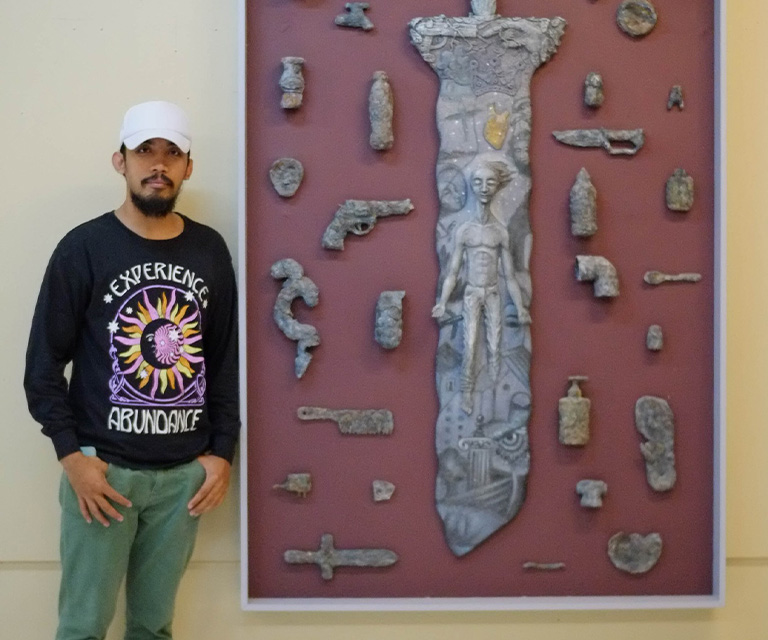
The vision for a collective exhibition first surfaced during the MADE awarding ceremony last September. In the afterglow of the applause, the artists recognized a shared truth: while awards open doors, longevity in the art world demands discipline, dialogue, and community.
Rather than dispersing into individual trajectories, they chose to build together. For Delmo, the collaboration with Punlaan Art Space felt organic. While the space provided the framework, the artists remained fully immersed in the process—shaping conceptual directions, organizing workshops, and participating hands-on in the curation.

Jeudi Garibay, Program Director of Punlaan Art Space, observed a striking level of vulnerability among the group. This openness, she noted, transformed the show into a true co-creation: artist-led and space-supported.
At its heart, Man Made challenges the enduring trope of the “lonely artist,” proposing instead a creative archetype rooted in solidarity rather than rivalry. The exhibition served as both a statement and an invitation, asking the next generation to imagine an art world where cooperation is not a compromise, but a strength.
This spirit of unity extends into the exhibition’s thematic core. In an era increasingly defined by generative AI and automation, the artists assert the irreplaceable role of human consciousness. Simbulan speaks of the “soul” embedded in human-made art—a depth and emotional imprint no algorithm can replicate. Jose, meanwhile, frames the exhibition as a cautionary reflection on society’s growing dependence on machines and the subtle erosion of our “human sense.”

The message is neither alarmist nor nostalgic; it is grounding. It serves as a reminder that art remains one of the most intimate expressions of the lived experience.
Though brought together by a contest, the seven artists quickly moved beyond the spirit of competition. What emerged instead was resonance—a recognition of shared visual languages and philosophical undercurrents.
“There are similarities in what our pieces express,” Simbulan reflects. “It feels like we found one another.”

That sense of “finding”—of choosing to stay connected after the spotlight fades—is perhaps the exhibition’s most compelling achievement. Professional recognition has evolved into friendship, and individual acclaim has transformed into collective momentum.
As entries open for the 2026 MADE cycle, the group’s advice to emerging artists is simple: begin now. If you have been waiting for the “right” moment, this is it. MADE is less about the prize and more about the platform—the visibility and the doors that open when your work finally meets the world.

Man Made stands as proof of what happens after the ceremony ends. In the hands of these seven artists, recognition became a relationship, and that relationship became a movement. In an age of automation, their message is both timely and timeless: the future of art remains, unmistakably, human.
Read more Stories on Simpol.ph
The Untold Story Behind the QWERTY Keyboard